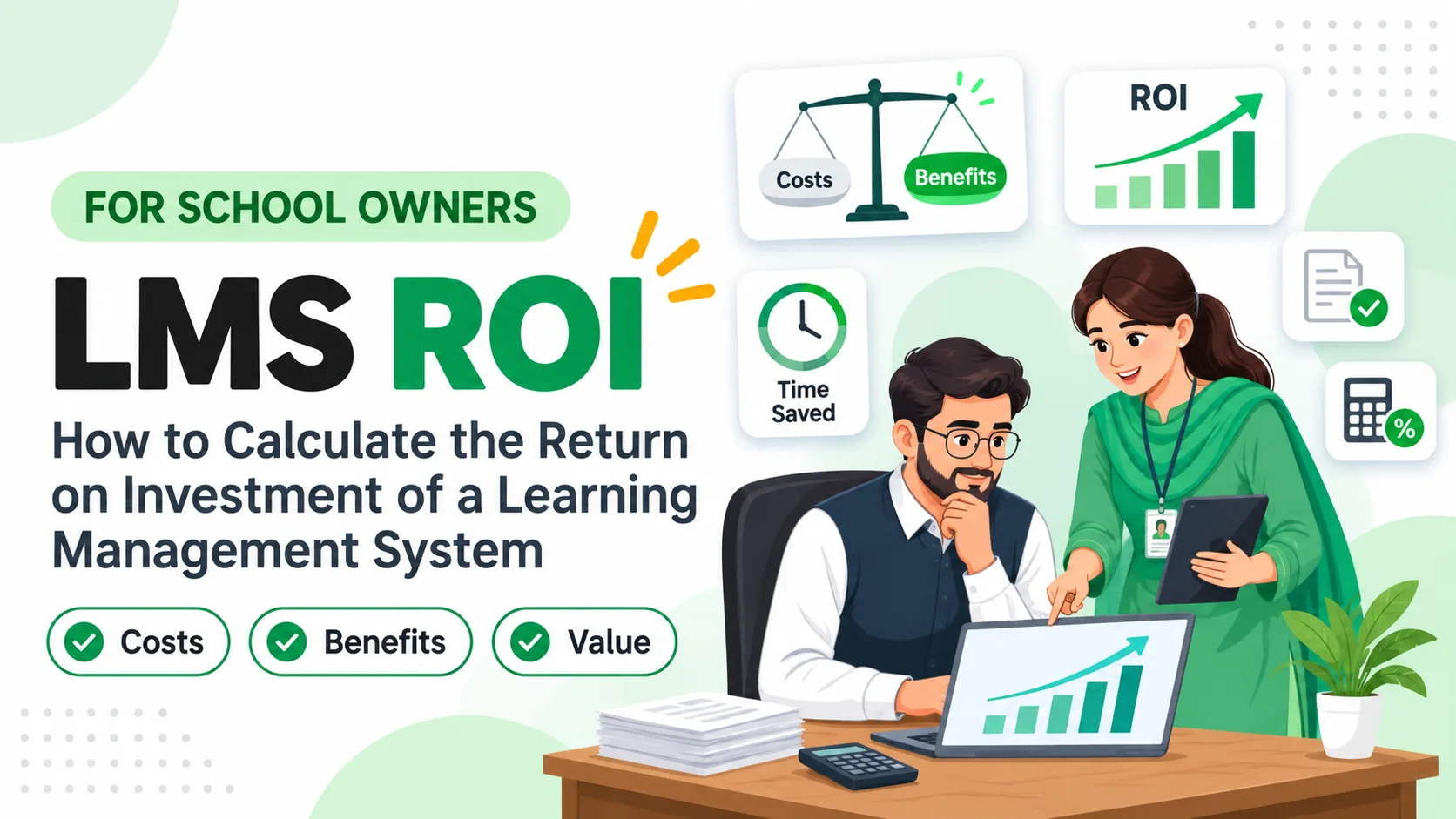
LMS ROI for Schools: How to Calculate the Return on Investment of a Learning Management System
Most school owners already accept that a learning management system (LMS) can help. The harder question comes when the quotation arrives: is it worth the money for our school? A vendor's list of benefits does not answer that. Neither does a competitor's decision to buy one.
This guide helps school owners, principals, and administrators build an honest investment case before they commit. It explains what return on investment (ROI) means for an LMS, which costs to include, which benefits can be measured, a simple calculation framework with a worked example, and how to judge value that does not show up in a spreadsheet. It does not promise a particular return, because no honest guide can. The answer depends on your school's costs, how the platform is used, and which benefits you can actually capture.
What Does ROI Mean for a School's LMS Investment?
Return on investment compares what a school gains from an investment with what it costs. For an LMS, the investment is everything the school spends to buy, set up, and run the platform over a period of time. The return is the value the school receives over the same period.
In a business, return is usually measured in money. In a school, it is broader. Some of the value of an LMS is financial, such as lower printing costs or fewer separate software subscriptions. Some is operational, such as less time spent compiling reports. Some is educational, such as teachers spotting struggling students earlier. A complete LMS ROI assessment looks at all three, while being honest about which can be converted into money and which cannot.
This distinction matters. A school that counts only cash savings may conclude that an LMS never pays for itself. A school that counts every hour saved as cash may convince itself that the platform pays for itself many times over. The truth is usually in between, and depends on what the school does with the time and information the LMS provides.
Why Schools Should Evaluate LMS ROI Before Investing
Schools operate on tight budgets, and an LMS is a commitment that usually runs for several years. Working through the ROI before buying helps school leaders to:
- Justify the spending: owners, boards, and governing bodies can see what the money is expected to achieve.
- Set realistic expectations: the school knows which benefits to expect, when, and what they depend on.
- Compare options fairly: different platforms, and the option of not buying one, can be judged on the same basis.
- Find the full cost: the exercise exposes costs that are easy to miss, such as training time and devices.
- Plan for success: if the return depends on teachers using the platform, the school knows to invest in training and adoption.
- Measure afterwards: a clear baseline makes it possible to check, a year later, whether the investment delivered.
If you are still deciding whether an LMS would help your school at all, our overview of the benefits of an LMS for schools is a better starting point. This guide assumes you are weighing a specific investment.
What Costs Should Schools Consider When Investing in an LMS?
The investment side of the ROI calculation should include every cost the school will bear, not just the subscription price. Estimate each cost over the same period, ideally three years, because first-year costs are usually higher than later years. Our guide to LMS pricing in Pakistan explains common pricing models in more detail.
Subscription or licensing fees
This is the recurring charge for using the platform, often priced per student, per user, or per school. Check what is included, whether prices rise at renewal, and how costs change if enrollment grows.
Implementation
Setting up the platform may involve setup fees, configuring classes and subjects, creating accounts, and moving existing content and records. Include the time your own staff will spend on implementation, not only what the vendor charges.
Training
Teachers, administrators, students, and parents all need some training. Count any training fees and the staff time spent in training sessions, including refresher training for new staff each year.
Support
Some vendors include support in the subscription. Others charge for higher support levels, faster response times, or a named contact. If the school will rely on its own staff to answer teachers' questions, include that time too.
Infrastructure and devices
An LMS is only useful if students and teachers can reach it. Consider whether the school needs more devices, better internet, a computer lab upgrade, or projectors. Some of these costs may benefit other activities as well, so decide fairly how much to attribute to the LMS.
Integration and customization
Connecting the LMS with school management software, or customizing reports and workflows, may involve extra charges. Ask for these in writing, because they are often left out of the first quotation.
Ongoing maintenance and renewal
Over time, the school will spend on renewals, adding new users, keeping content up to date, and possibly price increases. If the platform is self-hosted, include server, maintenance, and security costs as well.
What Benefits Can Schools Measure From an LMS?
Benefits are harder to measure than costs, and easier to overstate. For each benefit below, the key questions are: can we measure it, can we measure it before and after, and can any of it be converted into money?
Reduced repetitive administrative work where demonstrable
An LMS can reduce repeated tasks such as distributing materials, collecting assignments, recording marks, and compiling reports. Measure how long these tasks take now, then measure again after the platform is in use. Only count time savings you can actually demonstrate.
Assessment workflow efficiency
Automatic grading of suitable question types, digital submission, and results that flow into gradebooks can reduce marking and data entry time. Measure the time teachers spend creating, marking, and recording assessments before and after.
Access to student progress information
When results and submissions are recorded in one place, teachers and leaders can see who is falling behind without compiling data by hand. The value is in earlier support for students, which is hard to price but can be tracked through indicators such as assignment completion. Our guide to tracking student progress using an LMS explains what to measure.
Better coordination of learning activities
Shared courses, calendars, and resources help teachers coordinate across classes and subjects, for example to avoid several tests on the same day. This is usually a quality benefit rather than a financial one.
Parent visibility
When parents can see progress and announcements online, the school may spend less time answering routine questions and preparing paper reports. Measure the volume of routine inquiries and the cost of printed communication before and after.
Teacher workflow support
Reusable lessons, templates, and question banks can reduce preparation time from one year to the next. Benefits often grow in the second and third years, once teachers have built up content.
Improved availability of learning resources
Students who miss a lesson can catch up online, and resources are available for revision at any time. This can reduce time spent re-explaining and photocopying, though it is mainly an educational benefit.
How to Calculate LMS ROI for a School
The basic ROI formula is simple:
ROI (%) = (Total Benefits − Total Investment Cost) ÷ Total Investment Cost × 100
A positive result means the measured benefits exceed the cost. A negative result means they do not. The difficult part is not the arithmetic. It is deciding, honestly, what goes into each side. Use this calculator-style framework:
- Choose a time period. Three years usually gives a fairer picture than one, because first-year costs are higher and benefits take time to build.
- List every cost. Use the seven cost categories above, including staff time for implementation and training.
- Record a baseline. Before buying, measure how long key tasks take and what the school currently spends on printing, paper, and separate tools.
- Estimate cash savings. Include only money the school will genuinely stop spending, such as printing, paper, or software it will cancel.
- Estimate time savings separately. Calculate hours saved per week, multiply by working weeks, then by the cost of an hour of staff time.
- Decide how much time value to count. Time saved becomes a financial saving only if the school converts it, for example by reducing overtime, avoiding a new hire, or redeploying staff to work that would otherwise cost money. Otherwise, treat it as capacity, not cash.
- Calculate ROI twice. Once with cash savings only, and once including the time value you can justify. The real answer usually lies between the two.
- Record the non-financial benefits. List the educational and operational benefits you expect, with how you will measure them.
LMS ROI Calculation Example for a School
The example below is illustrative. All figures are hypothetical and chosen only to show the method. They are not typical prices, savings, or results for any platform, including Naseem Education. Use your own quotations and measurements.
Imagine a school with 600 students and 30 teachers, evaluating an LMS over three years.
Hypothetical costs
| Cost (hypothetical, PKR) | Year 1 | Year 2 | Year 3 |
|---|---|---|---|
| Subscription | 600,000 | 600,000 | 600,000 |
| Implementation and setup | 100,000 | 0 | 0 |
| Training (including staff time) | 80,000 | 40,000 | 40,000 |
| Devices and infrastructure attributed to the LMS | 120,000 | 0 | 0 |
| Total investment cost | 900,000 | 640,000 | 640,000 |
Hypothetical benefits
| Benefit (hypothetical) | Per Year |
|---|---|
| Reduced printing and paper costs | PKR 180,000 cash |
| Separate tools no longer needed | PKR 120,000 cash |
| Teacher time saved: 30 teachers × 1.5 hours a week × 36 weeks | 1,620 hours |
| Admin reporting time saved: 4 hours a week × 40 weeks | 160 hours |
| Total time saved, valued at a hypothetical PKR 400 per hour | 1,780 hours = PKR 712,000 |
Hypothetical ROI results
| Scenario | Year 1 | Three Years |
|---|---|---|
| A: Cash savings only (PKR 300,000 a year) | (300,000 − 900,000) ÷ 900,000 = −66.7% | (900,000 − 2,180,000) ÷ 2,180,000 = −58.7% |
| B: Cash savings plus full time value (PKR 1,012,000 a year) | (1,012,000 − 900,000) ÷ 900,000 = +12.4% | (3,036,000 − 2,180,000) ÷ 2,180,000 = +39.3% |
The two scenarios tell very different stories, and that is the point. On cash alone, this hypothetical school would not recover its investment. Once the value of time saved is included, the return becomes positive, especially over three years.
Which scenario is closer to reality depends on what the school does with those 1,780 hours. If teachers use the time for better feedback and planning, the school gains real educational value, but no cash. If the time saved avoids hiring an extra administrator or paying overtime, part of it becomes a genuine financial saving. School leaders should decide this honestly, and in advance, rather than counting every hour as money.
How to Measure LMS Benefits Beyond Financial Savings
For many schools, the strongest case for an LMS is educational and operational rather than financial. These benefits can still be measured. Choose a few indicators, record a baseline before launch, and review them each term:
| Benefit | How to Measure It |
|---|---|
| Faster feedback | Average days between submission and feedback |
| Assignment completion | Percentage of assignments submitted on time, by class |
| Earlier support | Number of students identified for support before term exams |
| Teacher workload | Hours a week spent on marking, recording, and reporting |
| Parent visibility | Number of active parent accounts and routine inquiries received |
| Resource access | How often students open shared materials and revision resources |
| Adoption | Percentage of teachers and students using the platform each week |
Adoption is the indicator to watch first. An LMS that teachers and students do not use cannot deliver any of the other benefits, however good its features. Evaluate features by the value they create in your school, not by how many the platform has. Our guide to key LMS features explains what each capability is for.
How Schools Can Evaluate LMS Investment Risks
A realistic ROI assessment includes the risks that could reduce the return, and how to limit them:
| Risk | How to Reduce It |
|---|---|
| Low teacher adoption | Involve teachers in the choice, train them properly, and pilot before a full rollout |
| Hidden or rising costs | Get every cost in writing, including renewal pricing and extra charges |
| Connectivity and device gaps | Test the platform on your own network and the devices students actually use |
| Poor fit with school structure | Ask the vendor to demonstrate your grades, sections, and campuses before buying |
| Vendor lock-in | Confirm you own your data and can export it, and agree fair exit terms |
| Benefits slower than expected | Plan for benefits to build over two to three years, not one term |
| Data and privacy problems | Review the vendor's data handling and security terms before signing |
Our guide to how to evaluate an LMS lists 20 questions that help uncover these risks before you buy.
Is an LMS Worth the Investment for a Small School?
Small schools face a different calculation. Their total costs are lower, but so are the benefits, because fewer teachers and students mean fewer hours saved. Fixed costs such as setup and training also make up a larger share of the budget.
An LMS can still be worthwhile for a small school when:
- Pricing scales with the number of students, so the school is not paying for capacity it does not need.
- The platform is hosted by the provider, so the school does not need its own technical staff.
- Teachers are spending significant time on repetitive tasks that the platform can reduce.
- The school wants to offer parents better visibility to stand out from competing schools.
- The school plans to grow and wants systems that can grow with it.
A small school should be cautious about paying for features it will not use, or about building a custom platform, which usually costs far more than a ready-made one. A short pilot with one or two classes is a low-risk way to test the value before committing.
What School Leaders Should Consider Before Investing in an LMS
Before signing, school leaders should be able to answer yes to most of these questions:
- Have we identified the specific problems we want the LMS to solve?
- Do we know the full cost over three years, in writing?
- Have we measured a baseline for the benefits we expect?
- Are we clear about which benefits are cash savings and which are time or educational value?
- Do our teachers support the decision, and do we have a training plan?
- Do our students and teachers have the devices and connectivity the platform needs?
- Have we confirmed data ownership, export, and exit terms?
- Have we planned how and when we will measure the return?
Local factors matter as well. Connectivity, devices, and budgets vary widely between schools in Pakistan, and our guide to LMS in Pakistan covers these considerations. For the wider buying and implementation journey, see our complete guide to choosing a learning management system for schools.
How Naseem Education Supports Schools' Digital Learning Goals
Naseem Education is a learning management system for schools that connects students, teachers, parents, and school leaders in one platform. It does not promise a particular return on investment, and no platform honestly can. What it offers are capabilities that relate to the benefits described in this guide:
- Course and assignment management: lessons, materials, and activities organized in one place, which supports teacher workflows and resource availability.
- Smart assessments: auto-grading where it applies, which relates to assessment workflow efficiency.
- Progress tracking and learning analytics: centralized progress information for teachers and a wider view for school leaders.
- Parent access: parents can view the progress information the school makes available through authorized accounts.
- Role-based portals: separate experiences for students, teachers, parents, and principals.
Whether these capabilities produce a return for your school depends on your costs, your baseline, and how the platform is used. The best way to find out is to apply the framework in this guide to a real quotation and, where possible, a pilot.
To start building your investment case, explore the Naseem Education LMS or request a demo and ask for a quotation you can test against your own figures.
Frequently Asked Questions
Ready to Bring Your School’s Learning Together?
Give your school a connected learning management system designed to support students, teachers, parents, and school leaders.