Parent Engagement in Schools: 12 Practical Strategies to Build Stronger Family-School Partnerships
Most schools already talk to parents. They send circulars, hold parent-teacher meetings (PTMs), and issue report cards two or three times a year. Yet many teachers will say that the parents they most need to reach are the ones they see least, and many parents will say they hear from the school only when something has gone wrong.
Parent engagement in schools is the work of closing that gap. It has less to do with how many messages a school sends than with whether families and teachers understand each other well enough to support the same child in the same direction.
This guide explains what parent engagement means, what the research does and does not show, and 12 strategies that teachers and school leaders can put into practice, including in schools with large classes, working parents, and families who are not online.
What Is Parent Engagement in Schools?
Parent engagement in schools is an ongoing partnership in which families and school staff share information, listen to each other, and act together to support a child's learning and development. The U.S. Centers for Disease Control and Prevention describes it as a shared responsibility, with school staff and parents working together for children's learning, development, and health.
Three ideas sit inside that definition.
First, engagement involves more than attendance. A parent who comes to every PTM but leaves without knowing what their child is working on, or how to help, has been present without being engaged. A parent who never visits the school but asks about the day's lessons every evening and replies to the teacher's note is engaged.
Second, communication runs in both directions. Schools know the curriculum, the classroom, and how a child is progressing against what is expected. Families know the child's history, health, temperament, worries, and what home life allows. Each side makes better decisions with the other's knowledge.
Third, engagement takes different forms. "Parent" here means whoever raises the child: a mother, father, grandparent, older sibling, or guardian. A family with two working parents, a household where a grandmother handles school matters, and a family whose home language differs from the language of instruction will not engage in the same way, and they should not be expected to. The Australian Department of Education takes the same broad view when it describes engagement as covering learning at home, at school, and in the community.
Why Is Parent Engagement Important in Education?
A teacher sees a child for a few hours a day, in a group of thirty, forty, or more. A parent sees the same child at home, usually without knowing what happened in class. When the two share what they know, several things become possible:
- Teachers understand students' needs sooner, because a parent mentions the poor eyesight, the long commute, or the new baby at home that explains a sudden change.
- Parents understand learning progress in terms they can use, beyond a percentage on a report card.
- Concerns are caught early, while a small gap can still be closed.
- Home and school give consistent messages about attendance, effort, and behavior, which reinforces the student engagement strategies teachers use in class.
- Conversations become better informed on both sides, so meetings produce decisions instead of complaints.
- The school builds trust with its community, which matters when it needs support for a change in policy, timing, or fees.
Research supports this, with qualifications. The CDC states that parent engagement is linked with better student behavior, higher academic achievement, and stronger social skills. The Education Endowment Foundation (EEF), drawing on 97 studies, estimates that parental engagement approaches add about four months of progress over a year on average. The effect is larger in the early years and primary grades than in secondary school.
Two cautions belong beside those figures. The EEF writes for schools in England, and the size of the effect should not be assumed for every school system. An average also hides wide variation. The same review notes that some common approaches show little benefit, and that if mainly better-off families take part, engagement can widen gaps between students instead of narrowing them.
Evidence from Pakistan points in a similar direction. In a randomized study published in the American Economic Review, researchers provided report cards with school and child test scores in half of a sample of Pakistani villages. In those villages, test scores rose by 0.11 standard deviations, private school fees fell by 17 percent, and primary enrollment rose by 4.5 percent. Clear information in families' hands changed what happened in schools.
Parent engagement does not automatically raise every student's grades. What it achieves depends on its quality, its consistency, and whether every family is able to take part.
Parent Engagement vs. Parental Involvement: What Is the Difference?
The two terms are often used interchangeably, and neither has a single agreed definition. Where writers do separate them, parental involvement usually describes parents taking part in activities the school has organized, such as a meeting, a sports day, or a prize-giving. Parent engagement places more weight on the relationship: parents and teachers exchanging information, making decisions together, and sharing responsibility for learning. The Annie E. Casey Foundation draws the line in a similar place. In its account, involved parents take part in what the school has planned, and engaged parents also contribute their own input.
| Aspect | Parental Involvement | Parent Engagement |
|---|---|---|
| Main focus | Participation in school activities | Ongoing partnership around the child's learning |
| Communication | Often school-led and one-directional | Two-way, with parents' knowledge actively sought |
| Parent role | Attending or helping | Collaborating and contributing |
| Where it happens | Mostly at school | At school, at home, and in the community |
| Example | Attending a parent-teacher meeting | Agreeing on a reading goal with the teacher and following up on it |
Researchers Janet Goodall and Caroline Montgomery describe the two as a continuum that runs from parents' involvement with the school to parents' engagement with their children's learning, and they argue that the greatest benefit comes from the engagement end. That is a useful way to hold the distinction. Involvement is not something to discard. A parent who starts by attending a sports day may, with the right invitation, end up in a conversation about reading at home.
School leaders will also meet Joyce Epstein's six types of involvement: parenting, communicating, volunteering, learning at home, decision making, and collaborating with the community. It works well as a checklist, because most schools find they are active in two or three types and quiet in the rest.
12 Practical Parent Engagement Strategies for Schools
The strategies below move roughly from the individual teacher to the whole school. No school needs to start all twelve at once. Each one covers what to do, why it helps, how to begin, an example, and a mistake to avoid.
1. Establish Consistent Two-Way Communication
Most school communication travels one way: notices about fees, holidays, uniform, and exam dates. Parents need that information, but it gives them no route to answer. Two-way communication means every family knows how to reach their child's teacher, when to expect a reply, and that their questions are welcome.
Set this up at the start of the year. Tell parents which channel the school uses (a diary note, a phone call during a fixed hour, a class messaging group, or an online platform), whom to contact for what, and how quickly a reply will come. Then ask something of them. A short "getting to know your child" form in the first two weeks, with three questions about what the child enjoys, what they find hard, and anything the teacher should know, tells families from the outset that their knowledge counts.
A Grade 3 class teacher, for example, might keep Tuesdays and Thursdays from 1:30 to 2:00 p.m. as a phone window and write it on the first page of every student's diary. Parents know when a call will be answered, and the teacher's evenings stay free.
Avoid promising more than staff can sustain. A teacher with 45 students cannot reply to messages at 10 p.m., and a channel that goes unanswered damages trust more than having no channel.
2. Make Parent-Teacher Meetings More Meaningful
For many families, the PTM is the only conversation they have with a teacher all term. In a large school it can last a few minutes, take place in a queue, and cover marks the parent has already seen. A Gallup Pakistan survey released in August 2026 found that 57 percent of parents of school-going children said a parent-teacher meeting had been held in the previous three months, with a gap between urban schools (66 percent) and rural schools (52 percent). The meeting is common but far from universal, which makes each one worth planning.
Prepare a few lines for each student before the day: one strength, one priority for the coming term, and one piece of evidence, such as a page of written work. Open by asking the parent what they have noticed at home. Spend most of the time on what happens next, and finish with one action for the teacher, one for the student, and one for the family. Where numbers are large, give time slots by roll number so that nobody waits two hours for a short conversation.
A Grade 6 mathematics teacher might show a parent two pages from the child's notebook, one from August and one from October, and say: "His working is far more organized now. The next step is word problems. Could he explain one homework problem aloud to you twice a week? You do not need to check the answer."
Do not let the meeting become a recital of grades or a list of complaints, and do not discuss one child within earshot of other families.
3. Share Positive Updates, Not Just Problems
If a parent hears from school only when something is wrong, they learn to dread the school's number. A short positive message changes what contact from school means, and it makes a later difficult conversation easier because some goodwill already exists.
Make the message specific. "Ayesha is a good student" tells a parent little. "Ayesha helped a new classmate find her way around this week without being asked" tells them something true about their child that they could not have seen themselves. Achievement, improvement, effort, and kindness all qualify.
The practical difficulty is fairness. Keep a class list and tick each name as a message goes home, aiming to reach every family at least once a term. Three diary notes a day, or five two-line messages on a Friday, will cover a class of 40 within a few weeks. Quiet students in the middle of the class are the ones most often missed.
Positive contact should not crowd out useful honesty. In a field experiment with high school students in a U.S. credit-recovery program, brief weekly messages from teachers to parents cut the share of students failing to earn course credit by 41 percent, and messages that named something the student could improve had the largest effect. Send both kinds, and make each one specific.
4. Provide Flexible Ways for Parents to Participate
A single meeting at 10 a.m. on a weekday suits the school. It does not suit a parent on a factory shift, a shopkeeper who cannot close, a daily-wage worker who loses income by attending, or a mother who would need to arrange travel and someone to mind younger children. Low attendance in these cases says more about the timetable than about how much parents care.
Offer more than one route. Hold meetings in two slots, such as an early morning and a late afternoon, or add a Saturday. Offer a ten-minute phone call to those who cannot come. Accept a grandparent, uncle, or older sibling as the family's representative where the family chooses that. Send a written summary home with the child when no meeting is possible. Punjab's teacher training module on inclusive education makes similar suggestions, including meetings at varied times or at home, and help with child supervision and transport.
Picture a school that splits its PTM into two sessions, 8:00 to 10:00 a.m. and 2:00 to 4:00 p.m., and offers phone slots the following week. A father who starts work at 10:30 can attend the first session, and a mother who cannot travel can take a call.
Avoid treating absence as indifference, and never let a child feel penalized because a parent could not come.
5. Help Parents Understand Their Children's Learning Progress
A report card that says "Mathematics: 62%, C" tells a parent where their child stands and nothing about what to do. Parents can act on progress information only when it names what the child can do now, what comes next, and how the child is moving over time.
Translate marks into plain statements: "Can add and subtract fractions with the same denominator. Next step: fractions with different denominators." Compare the child with their own earlier work as well as with the class. Teachers who use formative assessment already gather this kind of detail during lessons, so the task is to share a little of it, not to add more tests. For the wording of a short update, our guide to tracking student progress with an LMS includes a model with one strength, one area to improve, and one way to help.
At a secondary school, a subject teacher might send home a half-page mid-term note for each student, marking three topics as "secure," "developing," or "not yet," with one suggested action. A parent who cannot follow the physics can still see which topic needs attention and ask about it.
Avoid sending raw data without interpretation. A stream of quiz scores can alarm a family over one bad day, and a class rank on its own invites comparison between children instead of support for one.
6. Organize Parent Workshops and Learning Sessions
Many parents want to help and are unsure how, particularly when their own schooling was short or took place in a different language or system. A workshop gives them a few practical techniques and, just as usefully, a chance to meet teachers when nothing is at stake.
Keep sessions short, practical, and tied to something parents can do that week. Useful topics include:
- Setting up a homework routine: a fixed time and place, and what to do when a child is stuck.
- Reading at home, including how a parent who does not read English or Urdu confidently can still listen, ask about the pictures and the story, and tell stories in the home language.
- Study habits for older students, such as planning a week and revising in short sessions.
- Age-appropriate use of phones and online learning.
- Talking with children about school, using questions that draw out more than "fine."
A 40-minute session for parents of Grade 1 students, held straight after morning drop-off, could demonstrate three ways to listen to a child read, let parents try them in pairs, and send each family home with one book.
The aim is not to turn parents into teachers. The EEF's review finds that involving parents directly in homework is generally not linked with higher attainment, particularly at secondary level. Its guidance report, Working with Parents to Support Children's Learning, advises schools to encourage good homework habits and to be cautious about promoting direct help with homework for older children. A meta-analysis of 50 studies of middle school students by Nancy Hill and Diana Tyson reached a similar conclusion. Most forms of involvement were associated with higher achievement, help with homework was the exception, and the strongest association was with what the authors call academic socialization: parents communicating expectations, discussing learning strategies, and connecting school to the child's future plans. These findings are associations, not proof of cause. They do suggest that showing interest, keeping routines, and talking about why school matters are within every parent's reach, whatever their own education.
Avoid lecturing. Parents who sit silently for an hour and hear what they are doing wrong will not come twice.
7. Encourage Parent Participation in School Activities
Events bring families into the building and let them see the school as a place where they belong. They work best when participation has a purpose beyond filling seats. A parent might read or tell a story to a class. A tailor, nurse, mechanic, or shopkeeper might describe their work on a careers day. Families can contribute to a cultural day or science exhibition, and grandparents can share local history for a social studies project.
Offer roles of different sizes so that every family can say yes to something. Some parents can give a morning. Others can send a recipe, lend a tool for a display, or record a two-minute voice message for the class in their home language. Ask personally where possible, since a direct invitation from the class teacher is harder to overlook than a general circular.
Keep participation voluntary and free of cost. A "bring a dish" event or a costume requirement can exclude the very households the school most wants to include. Avoid relying on the same five confident parents for everything.
8. Listen to Parents and Consider Their Feedback
Parents notice things the school cannot: how long homework really takes, whether their child feels safe on the way home, which notices never arrive. Asking for their views improves decisions and shows respect.
Collect feedback in more than one way. A short survey works, on paper as well as online, with five questions at most. So do informal conversations at the gate, a suggestion box, phone calls to a few parents who rarely attend, and the school's parent body. In Pakistan that body may be a school council, a school management committee, or a parent-teacher council. Explain its role to families, because many do not know it exists. In focus groups described in ASER Pakistan 2019, many parents were unaware of school management committees or of an official complaints hotline.
Then close the loop. Tell parents what you heard and what you will do, including what you cannot change and why. A notice that reads, "You told us homework in Grades 4 and 5 was taking more than two hours. From next month, teachers will coordinate so that no more than two subjects set written homework on the same day," does more for trust than the survey itself.
Avoid collecting opinions and then going silent. Asking and ignoring is worse than not asking.
9. Make Communication Accessible to Different Families
No single channel reaches every family. Some parents read English comfortably, others prefer Urdu or a regional language, and some do not read with confidence in any language. Some have a smartphone with a data package, some share one phone across the household, and some have a basic handset.
Phone access should not be assumed, especially for mothers. Figures from the GSMA's Mobile Gender Gap Report 2026, reported by Arab News, show that 68 percent of women in Pakistan own a mobile phone, compared with 93 percent of men, and that 40 percent of women own a smartphone. A message sent only to a smartphone group may reach a father's phone at work and never reach the parent who supervises homework.
At admission, ask each family three things: which language they prefer, which channel works for them (written note, call, text message, or messaging app), and whose number to use. Keep important messages short, in plain words, and available in at least two forms. A voice note can carry the same information as a written circular for a parent who prefers to listen. For parents with a hearing or visual impairment, ask what works and record it. Sindh's Early Childhood Care and Education Standards set a similar expectation for early years settings, calling for several ongoing methods of communication, information in the languages families use, and translators at meetings where needed.
Avoid using children as interpreters for sensitive conversations, and do not treat a messaging group as proof that everyone has been informed.
10. Involve Parents in Appropriate Learning Goals
Parents can support a learning goal only if they know what it is. At the start of a term or unit, share two or three objectives in everyday language, with one thing families can do. "This term in Grade 2 we are learning to tell the time. Ask your child to read the clock at meal times" is enough.
For an individual student, agree on one goal with the parent and, where the child is old enough, with the student too. This matters most in schools working toward personalized learning, because a parent who knows the child's current target can reinforce it. Keep the home part small and achievable in ten minutes without special materials. A Grade 5 teacher and a parent might agree that the child will read aloud for ten minutes on four evenings a week, with the parent simply listening and signing the diary.
Professional boundaries matter here. Teachers decide how to teach, what to assess, and how to grade. Parents contribute knowledge of the child and support at home. Involving parents in goals does not mean negotiating the curriculum or handing over the teaching. Avoid home tasks that depend on a parent's own schooling, on paid tuition, or on a device the family may not have.
11. Build Relationships With Parents Before Problems Arise
The first contact between a parent and a teacher sets the tone for the year. If it is a complaint, the parent arrives at every later conversation on the defensive. If it is a welcome, a later concern is heard as coming from someone who knows and likes their child.
Use the first month. Hold a short orientation for each class, send an introductory note, or make a two-minute call to each family: who you are, what the class will be working on, and how to reach you. Learn how each family prefers to be addressed. For new students and at transition points, such as the move into Grade 1 or Grade 6, a little extra contact prevents a good deal of anxiety. The Dual Capacity-Building Framework for Family-School Partnerships, developed by Karen Mapp and colleagues, places being relational and built on mutual trust first among its conditions for effective partnership, alongside being linked to learning.
A class teacher with 36 students might divide the class into four groups and call nine families a week through the first month. By the end of it, every parent has spoken to the teacher once about something other than a problem.
Avoid the pattern in which the only parents a teacher knows by name are those of students in difficulty.
12. Review and Improve the School's Engagement Approach
What a school does not review tends to drift back to circulars and an annual meeting. Once a term, a small group (a senior leader, two or three teachers, and ideally a parent) should look at what happened and who was missed. The EEF's guidance report makes this its first recommendation: critically review how the school works with parents.
Useful indicators are simple ones that a school can compare with its own earlier figures:
| What to Look At | What It Tells You |
|---|---|
| Share of families with at least one two-way contact this term | Reach, as opposed to the volume of messages sent |
| Which families had none, by class | Who is being missed, and whether there is a pattern |
| PTM attendance by time slot and by route (in person or by phone) | Whether the flexible options are being used |
| Balance of positive or neutral contacts and problem contacts | Whether the school is known only for bad news |
| Parent feedback received and action taken in response | Whether listening leads to change |
| Time teachers spend on parent communication | Whether the approach is sustainable |
Treat these as questions for your own school, not as targets borrowed from elsewhere. There is no universal benchmark for a good PTM attendance rate, and a school serving families who work long shifts will have different numbers from one that does not. Break figures down where you can, because an overall rate of 70 percent can hide a class or neighborhood where almost nobody was reached.
Avoid measuring only what is easy to count. The number of messages sent says nothing about whether anyone felt heard.
Examples of Effective Parent Engagement in Schools
The four scenarios below are illustrations, not case studies of named schools. They show how the strategies combine in practice.
Example 1: A School Improving Parent-Teacher Communication
A private primary school with about 600 students has relied on a termly PTM and class messaging groups used mainly for reminders. Teachers feel that parents appear only when marks drop. The principal makes three changes for the new year. Each teacher publishes two weekly phone windows, each family receives a three-question form in the first two weeks, and every student gets one positive note home each term, tracked on a class list. At the end of term, staff identify the families who had no two-way contact and call them. The messaging groups continue, but they are no longer the school's only voice.
Example 2: Supporting a Student Who Is Struggling Academically
Hamza, in Grade 7, has stopped handing in science homework and scored poorly on two quizzes. His teacher does not wait for the PTM. She phones home, starts with what Hamza does well in practical work, describes the missing homework and quiz results factually, and asks what his mother has noticed. His mother explains that he now helps at his uncle's shop until 8 p.m. Together they agree that Hamza will do science homework in a free period on Tuesdays and Thursdays, that the teacher will check it on the spot, and that his mother will ask him one question about the lesson on those evenings. They speak again after three weeks. Nothing in the plan requires his mother to teach science.
Example 3: Encouraging Parent Participation in School Activities
A school's annual science exhibition has always been a weekday-morning event attended by a small group of mothers. This year, the school offers four ways to take part. Parents can visit in a morning or late-afternoon slot, lend household materials for models, record a short voice message explaining a trade or skill related to a project, or look through photographs sent home afterward and discuss one project with the child. Teachers record participation across all four routes, so a father who sent a voice message about repairing motors counts as much as a parent who attended.
Example 4: Helping Parents Understand Student Progress
A secondary school replaces its marks-only mid-term slip with a short summary for each subject: two things the student can now do, one priority for next term, and one suggestion for home. Teachers review results before release and add a one-line comment. Families who use the school's online platform see the summary there, and a printed copy goes home with every student regardless. At the PTM, conversations start from the priority instead of the percentage.
How Teachers Can Improve Parent-Teacher Communication
School policy sets the conditions, but most parents experience the school through one or two teachers. A few habits make those conversations more productive.
- Set expectations early. Tell parents how and when to contact you and how soon you will reply, then keep to it.
- Choose the channel to fit the message. A reminder suits a written note or text. Praise can go by note or message. A concern about learning or behavior deserves a call or a meeting, where tone can be heard and questions answered.
- Use plain, respectful language. Terms such as "formative," "SLOs," or "below grade-level expectations" need a short explanation or a simpler substitute.
- Describe what you observed instead of labeling the child. "Lazy," "weak," and "careless" are judgments that a parent can only accept or resent. "He has not handed in three of the last five assignments" is something a parent can ask about.
- Listen without becoming defensive. When a parent criticizes, look for the request inside the complaint before answering.
- Protect confidentiality. Do not discuss a child in a group chat, at the gate in front of others, or with another parent.
- Agree on realistic next steps, and follow up. Name a date, and make the call on that date.
When raising a concern, a four-part structure helps: begin with something true and positive, describe the observation, ask for the parent's view, and agree on one step each. Compare two versions of the same message.
Less helpful: "Sara is very careless in mathematics and does not pay attention. Please make her work harder at home."
More helpful: "Sara takes part well in class discussions. In her last three mathematics tests, she lost marks on multi-step problems, mostly by skipping a step and not by misunderstanding the method. Have you noticed anything similar when she does homework? In class, I will ask her to write each step on a separate line. At home, could she explain one problem aloud to you twice a week? I will call you on the 15th so we can see how it is going."
The second version takes a minute longer to write. It gives the parent a specific picture, asks what they know, and leaves both adults with something to do.
What Prevents Effective Parent Engagement?
When parents do not engage, the cause is usually practical or historical. Few parents are indifferent to their children's education. The table lists common barriers and a realistic response to each.
| Barrier | What It Looks Like | How a School Can Respond |
|---|---|---|
| Work schedules and limited time | Parents miss weekday meetings; daily-wage earners lose income by attending | Two meeting slots, phone alternatives, written summaries |
| Distance and travel | Families live far from school, or a parent cannot travel alone | Phone conversations, meetings timed with pick-up, home visits where appropriate and welcome |
| Language and literacy | Circulars in English go unread | Home-language or bilingual notices, voice notes, plain wording, a staff member who can interpret |
| Limited digital access | No smartphone, a shared phone, or no data | Paper and phone routes kept alongside any app; essential information never sent by app alone |
| Previous negative school experiences | Parents feel judged or unwelcome, sometimes because of their own schooling | A warm first contact, front-office courtesy, meetings that begin with strengths |
| Problem-only communication | Parents avoid calls from school | Regular positive and neutral contact (strategies 3 and 11) |
| Lack of trust | Parents doubt that speaking up will help, or fear it will affect their child | Confidentiality, visible action on feedback, consistency over time |
| Unclear expectations | Parents do not know what the school wants from them | A one-page guide at admission: how we communicate, what we ask of you, what you can ask of us |
| Large school communities | Individual contact feels impossible | Contact spread through the term, shared among class and subject teachers, tracked on a class list |
| Limited staff capacity | Teachers have no time for calls | Protected time in the timetable, simple templates, modest goals such as one two-way contact per family per term |
Two points deserve emphasis. None of these barriers is a fault in parents, and most lie outside their control. The school is the party with the ability to adjust. Staff capacity is also a real constraint. Asking teachers to engage parents without giving them time to do it moves the burden without solving the problem.
How Can Schools Build Stronger Family-School Partnerships?
Individual teachers can do a great deal, but engagement lasts only when the school plans for it. The U.S. Department of Education's resource on strategies for equitable family engagement groups its advice under headings that include committing to engagement, making it routine practice, and building relationships between staff and families. A school can follow a similar sequence across a year.
- Establish clear engagement goals. Choose two or three for the year and link them to learning, such as "every family has a two-way conversation with the class teacher each term" or "every parent of a Grade 1 student knows how to listen to their child read."
- Understand the needs of different families. Use admission forms and a short survey to learn languages, preferred channels, working hours, and who handles school matters at home.
- Create accessible communication channels. Decide the school's main routes, keep an offline option for each, and publish whom to contact for what.
- Train staff in respectful family communication. Use a staff meeting to practice the four-part structure for raising a concern and to agree on words the school will not use about children.
- Encourage parent feedback. Schedule it, with one short survey and one open forum a year, and report back on what changed.
- Provide meaningful opportunities for participation. Plan events with roles of different sizes and at different times, and make use of the school council or parent body.
- Maintain consistent communication. Put contact points in the school calendar: a first-month welcome, a mid-term progress note, the PTM, and an end-of-term summary.
- Review the approach regularly. Look at the indicators from strategy 12 each term and adjust.
Leadership behavior is what turns this from a project into part of the school's culture. Principals who stand at the gate, return parents' calls, give teachers time for contact, and ask in staff meetings, "Which families have we not heard from?" signal that working with families is part of the job and not an extra.
How Technology Can Support Parent Engagement
Technology can make several of these strategies easier to sustain. Digital channels carry announcements quickly, reduce the problem of lost circulars, and let a teacher send the same information to a whole class in one step. Shared progress information means a parent need not wait for the report card. Records of who was contacted, and when, make the review in strategy 12 possible without extra paperwork.
Simple tools have evidence behind them. An EEF-funded trial involving 29 schools and 15,697 secondary students in England tested text messages to parents about upcoming tests, homework, and what students were learning. It found about one additional month of progress in mathematics and reduced absenteeism, at a cost of no more than about £6 per student per year. The effect was small, and so was the cost.
The limits deserve equal attention:
- Not every family has a device, data, or the confidence to use an app, as the phone-ownership figures above show.
- Information about a child should be visible only to that child's family and the staff who need it, and group chats are a poor place for anything individual.
- Ten alerts a day teach parents to ignore all of them. Fewer, better messages work.
- A score delivered instantly and without context can worry a family more than it informs them.
- Difficult conversations still belong on a call or in a room.
Installing software does not create engagement. It gives a school that already intends to work with families a more reliable way to do so. Schools weighing the options can start with the benefits of an LMS for schools and, for local considerations such as connectivity and devices, our guide to choosing an LMS in Pakistan.
How a Learning Management System Supports Parent Engagement
A learning management system (LMS) is the platform a school uses to organize courses, assignments, assessments, and progress records. Many school-focused systems include parent-facing access. Depending on the platform and what the school chooses to enable, that can include:
- A view of the child's learning progress and academic performance.
- Achievements and recent learning updates.
- Areas where the child may need additional support.
- School information and, where the platform provides them, communication features.
The value for engagement lies in timing and detail. A parent who can see that a topic needs attention can raise it with the teacher in week five instead of discovering it in a term report, and a PTM can start from information both sides have already seen.
Making information available is not the same as building a relationship. Access that nobody has explained, or that shows numbers without meaning, will go unused. Schools get more from it when they decide carefully what parents should see, introduce it with a short orientation, keep a non-digital route for families who need one, and treat the information as the start of a conversation. If you are evaluating this capability, our page on the Parent Portal for schools explains how parent access works.
How Naseem Education Supports Parent Engagement
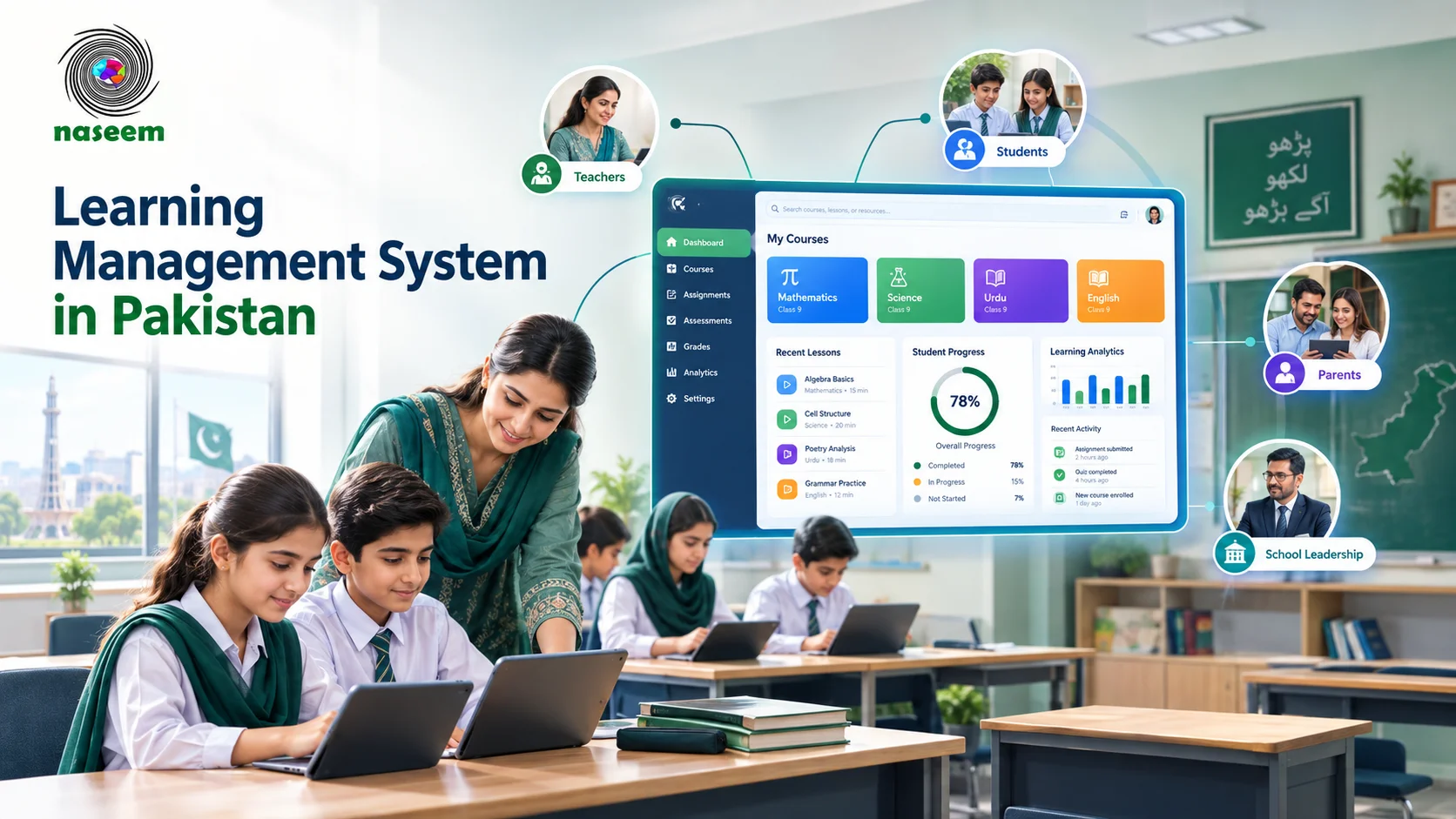
Naseem Education is a learning management system for schools that connects students, teachers, parents, and school leaders in one environment. For parents, the platform is designed to provide visibility into their child's learning progress, academic performance, achievements, and areas that may need additional attention, through authorized accounts that the school arranges.
That visibility supports several practices in this guide. Parents can follow learning between report cards, as strategy 5 recommends. Information about achievements gives teachers and parents something positive to talk about, in the spirit of strategy 3. Seeing where a child needs support allows the earlier and more specific conversations described in strategy 11. Because teachers and school leaders work from the same learning information, a meeting with a parent can draw on a shared record.
The platform does not replace the phone call, the welcome at the gate, or the teacher who knows a child well. Each school decides what parents can view, so ask during a demonstration exactly which information and communication options are available to parent accounts. You can read more about Naseem Education's Parent Portal, or request a demo to see how it would fit your school's way of working with families.
Building a Stronger Connection Between Schools and Families
Parent engagement is not measured by the size of the crowd at a meeting or the number of messages sent in a term. It shows whether a parent knows what their child is learning, whether a teacher knows something of the child's life outside school, and whether the two can talk before a small difficulty becomes a large one.
The strategies in this guide share a few principles. Begin the relationship before there is a problem. Communicate in both directions. Tie conversations to learning. Make sure every family has a way in, including those who are busy, far away, or offline. None of this requires a large budget, but all of it requires consistency.
Technology can help a school share learning information reliably, and a platform such as Naseem Education can give parents a clearer view of their child's progress. The relationship itself is still built by people: a teacher who calls with good news, a principal who listens, and a parent who feels welcome to ask.
Frequently Asked Questions About Parent Engagement in Schools
Ready to Bring Your School’s Learning Together?
Give your school a connected learning management system designed to support students, teachers, parents, and school leaders.