How to Use AI for A Level Exam Preparation: A Practical Guide to Smarter Practice
Preparing for A Levels can become difficult when you are trying to balance several subjects, revise large amounts of material, and work out whether you are genuinely ready for the examination. You might understand a chapter while reading it but struggle to answer questions without your notes. You might finish a past paper and still be unsure why you lost marks. Or you might need more practice on a topic but have already worked through the questions available in your textbook.
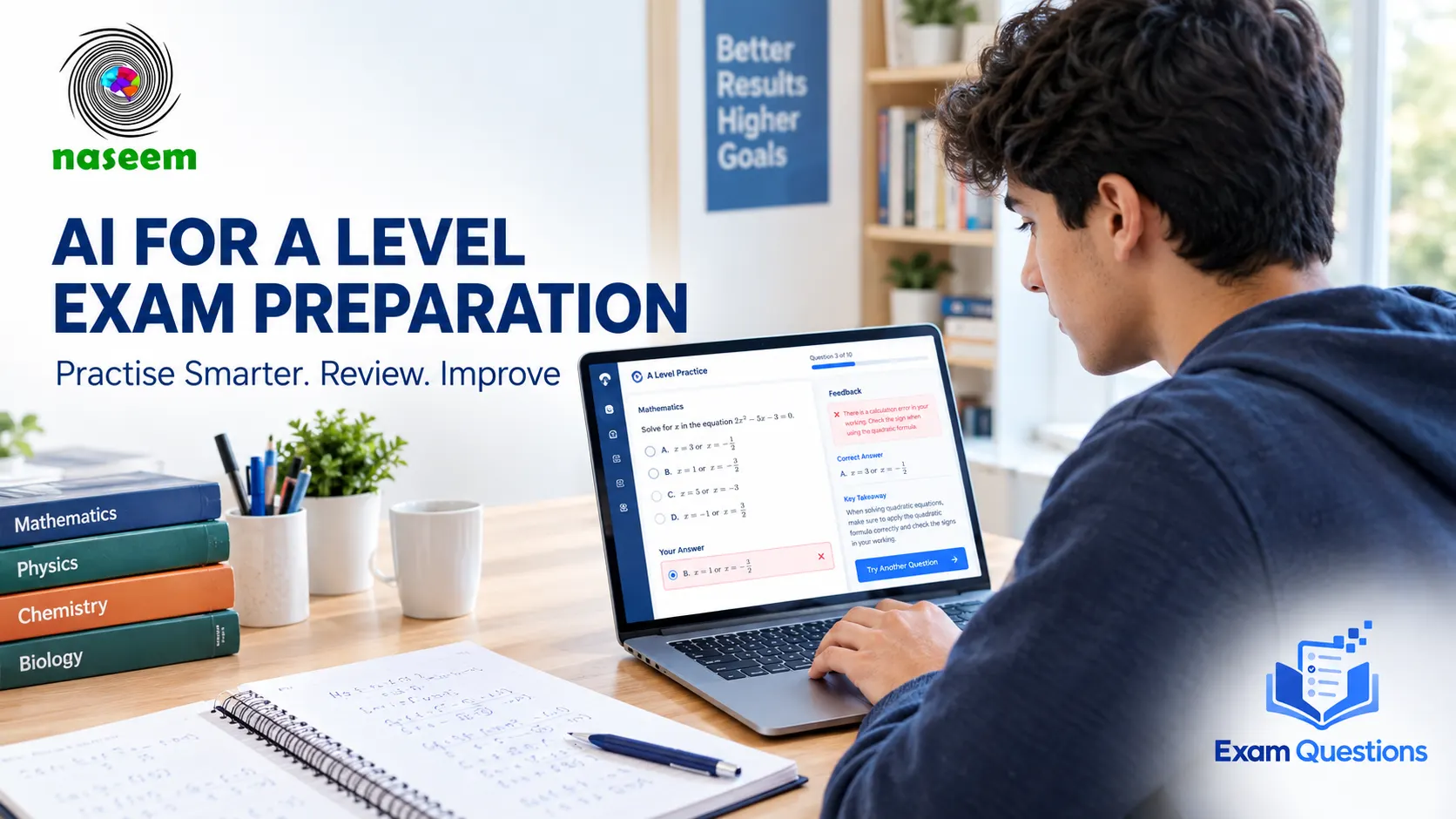
Artificial intelligence can offer another way to approach these problems. Depending on the tool, AI may help you create additional practice questions, review explanations, organize revision activities, or receive feedback on an answer.
However, using AI effectively requires more than entering a subject name and asking for a list of questions. The quality of your preparation still depends on the accuracy of the materials, their relevance to your examination, and the effort you put into answering questions independently.
AI-generated content can also contain mistakes. A question may be poorly worded, an explanation may omit an important step, or an automated assessment may not reflect the requirements of your examination board. That is why AI should complement official resources and established study methods rather than replace them.
For Cambridge International students, the starting point remains the official Cambridge International AS & A Level qualifications website. Use the relevant syllabus and examination materials to understand what you need to learn before choosing additional tools.
This guide explains how to use AI for A Level exam preparation, where it can help, what to verify, and how to build a practical revision routine around independent practice.
1. Understand What AI Can and Cannot Do
Before choosing an AI study tool, be clear about the task you want it to perform.
Different products offer different features. Some can generate questions from a topic description, some can explain concepts, and others provide automated feedback on answers. A product may offer one or several of these capabilities, and the quality of its results can vary.
Where AI can help
AI can be useful when you need additional opportunities to practice a concept or want an alternative explanation of something you find difficult.
For example, a Mathematics student may ask for additional questions involving differentiation. A Biology student may want to practice explaining a biological process. A Business student may want to work through questions that require applying a concept to a case study.
If the tool supports these tasks, it can help you create more opportunities to test your understanding.
AI may also help you organize a study session. You could use it to turn a list of weak topics into a revision checklist or suggest a sequence of activities that moves from concept review to independent practice.
These suggestions should be treated as a starting point. Your syllabus, teacher's guidance, examination timetable, and actual performance should determine your final priorities.
Where AI can make mistakes
AI systems can produce incorrect facts, calculations, explanations, or answers. They may misunderstand a question or generate material that does not match the expected examination standard.
This matters because an answer can sound confident while still being wrong.
For example, an automatically generated mathematical solution may contain an algebraic error. A scientific explanation may omit an important condition. A longer written answer may receive positive-sounding feedback despite missing a requirement in the mark scheme.
Do not accept an answer simply because it is presented clearly.
Check important claims against trusted subject materials, official examination resources, and teacher feedback. If an explanation conflicts with a reliable source, investigate the difference before using it in your revision.
AI is not a substitute for learning
The purpose of using AI should be to improve your ability to answer questions yourself.
If a tool produces a complete answer and you immediately memorize it, you may feel prepared without developing the ability to reproduce the reasoning independently.
A more useful approach is to attempt the question first, review the feedback afterwards, and then try a similar question without assistance.
That process helps keep the focus on learning rather than collecting answers.
2. Start With Your Official A Level Syllabus
One of the easiest mistakes to make with AI-assisted revision is to practice whatever the tool happens to generate.
A question can be interesting and academically valid without being relevant to your examination. Before generating additional practice, establish what your course actually requires.
Find the correct syllabus
If you are studying Cambridge International A Levels, use the official Cambridge International AS & A Level subject directory to locate your subject and check its syllabus information.
Confirm the subject code and relevant syllabus version. For example, Cambridge International A Level Mathematics uses subject code 9709, while Physics uses 9702, Chemistry uses 9701, and Biology uses 9700.
Do not assume that a resource designed for a different examination board will cover the same content or assessment requirements.
Turn the syllabus into a revision checklist
Once you have the relevant syllabus, break it into manageable sections.
For each topic, record whether you can:
- Explain the main concepts without referring to notes.
- Recall relevant definitions, equations, or terminology.
- Apply the knowledge to an unfamiliar problem.
- Complete relevant examination-style questions.
- Explain why your answer is correct.
This checklist provides a more useful basis for revision than a generic list of topics generated by an AI tool.
It also helps you decide what to ask the tool to do. Instead of requesting questions about an entire subject, specify the topic or skill you want to practice.
Use official examination resources as your reference point
Cambridge International provides past papers, mark schemes, specimen papers, and other subject resources where available. Its teaching, learning and assessment guidance explains the role of these materials in preparing learners for examinations.
Use official materials to understand the relevant question formats and assessment expectations. AI can help create supplementary practice, but it should not decide the syllabus on your behalf.
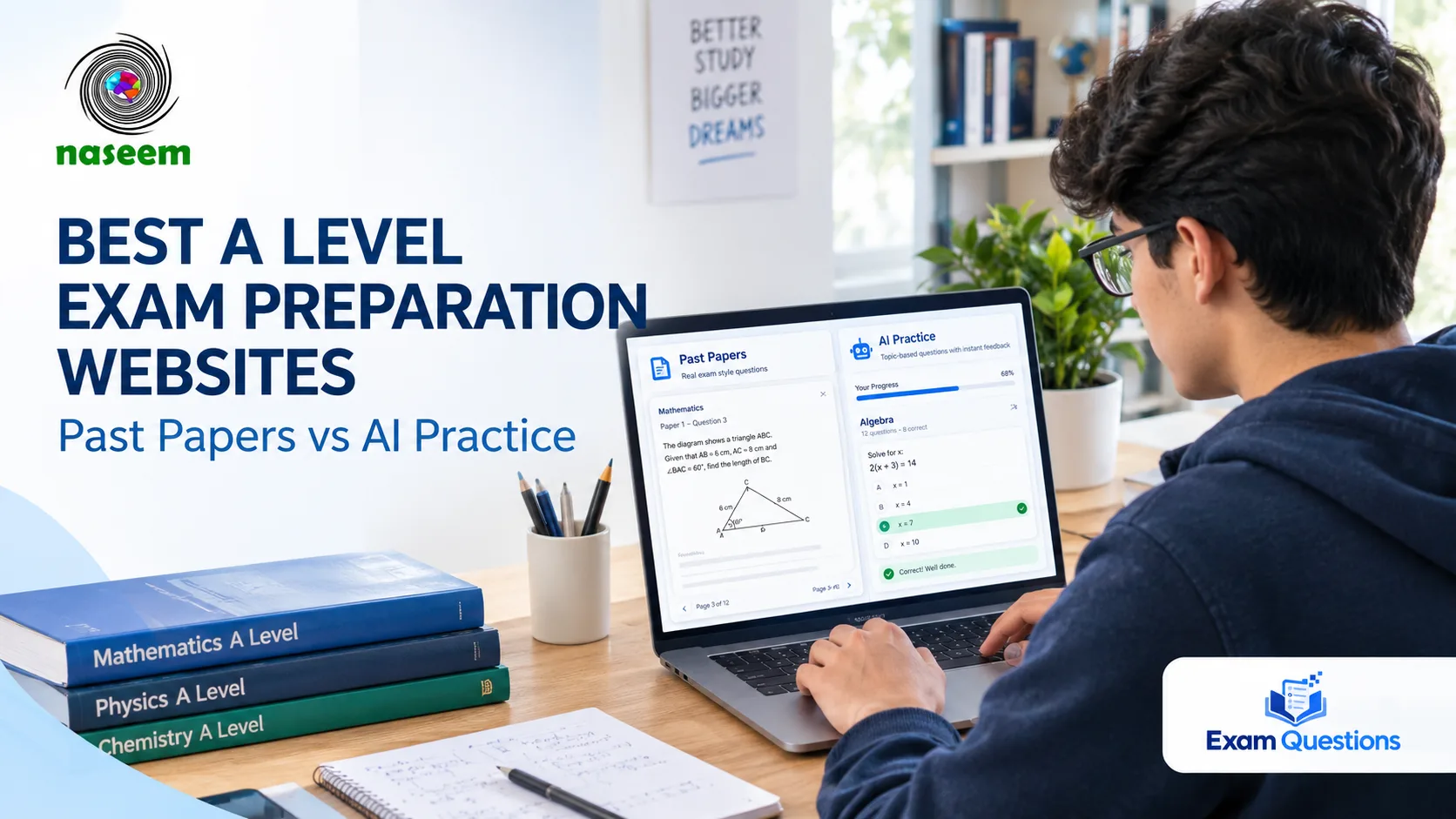
For a broader comparison of past papers, revision websites, question banks, and other preparation resources, see our guide to the best A Level exam preparation websites and tools.
3. Use AI to Generate Additional Practice Questions
Additional practice is one of the most straightforward ways AI can support revision, provided the questions are checked for relevance and accuracy.
Students sometimes finish the available textbook exercises or need several variations of a question to understand a method. An AI tool may help provide further examples, particularly when the request is specific.
Ask for focused questions rather than an entire examination
Suppose you are studying a Mathematics topic and need more practice with a particular method.
Instead of asking an AI tool to create a complete A Level Mathematics paper, ask it to generate a small set of questions on the specific skill you are revising.
Your request should identify the subject, topic, level, and type of task. If appropriate, ask for a range of difficulty levels and request that answers be withheld until you have attempted the questions.
The resulting material still needs checking. A question described as A Level standard may not accurately reflect the difficulty, structure, or syllabus coverage of your actual examination.
Attempt questions before revealing solutions
The order matters.
Read the question, work through it independently, and write down your reasoning. Only review the solution after you have made a genuine attempt.
If you immediately read the generated answer, it becomes easier to recognize the method without learning to reproduce it.
After reviewing a solution, close it and try the question again from memory. Then attempt a different question that tests the same skill.
This gives you a better indication of whether the explanation has helped you learn.
Check the questions before relying on them
Look for ambiguous wording, missing information, incorrect assumptions, and content that falls outside your syllabus.
For numerical questions, verify the calculation and any units or conditions that matter. For longer written responses, check whether the task resembles the assessment requirements you are preparing for.
If you cannot verify a generated question or answer, do not treat it as an authoritative examination resource.
4. Use AI to Understand Mistakes, Not Just Get Answers
One of the most useful parts of revision is understanding why you lost marks.
A wrong answer can result from several different problems. You may have forgotten a fact, misunderstood a concept, selected an unsuitable method, made a calculation error, or failed to explain your reasoning clearly.
These problems require different responses.
Identify the type of mistake
After attempting a question, record what went wrong.
For example:
- Knowledge gap: You could not recall the relevant principle. Return to your textbook or trusted notes and review the concept.
- Application problem: You knew the principle but could not determine how it applied to the question. Work through examples and practice identifying which information is relevant.
- Method error: You chose an unsuitable approach or skipped a necessary step. Review the method and practice it independently.
- Communication problem: Your answer contained some correct ideas but did not explain them clearly enough. Study the relevant mark scheme and practice constructing a more complete response.
- Time-management problem: You understood the question but took too long. Practice similar questions with a realistic time limit after you understand the method.
An AI tool may help you examine these possibilities, but its interpretation should not be accepted automatically.
Ask for an explanation of the reasoning
When a tool provides feedback, focus on the underlying reason rather than asking only for the correct answer.
For a mathematical problem, you might want to understand why a particular method applies. For a scientific explanation, you may need to identify a missing step. For a longer response, you may need to understand which parts of the argument require more evidence or development.
Compare the explanation with a trusted source. If the feedback is useful, record the lesson in your error log.
Keep a record of recurring mistakes
A simple error log can help you identify patterns across several practice sessions.
| Date | Topic | Mistake | Next action |
|---|---|---|---|
| Monday | Differentiation | Applied the wrong rule | Review the method and solve new questions |
| Tuesday | Biology | Explanation missed a key step | Revisit the process and practice a structured answer |
| Wednesday | Economics | Evaluation was too general | Practice linking arguments to the given context |
The examples above are illustrative. Your own log should reflect your actual mistakes.
Review the log weekly. If the same error appears several times, prioritize it in your next revision session.
5. How to Use AI-Assisted Marking and Answer Feedback
Some exam-preparation platforms offer AI-assisted marking or feedback. These features may help students review responses, identify potential weaknesses, and decide what to revise next.
However, automated feedback is not the same as an official examination result.
Understand what automated marking can tell you
Depending on the tool and question type, AI feedback may highlight missing information, suggest improvements to an explanation, or help you compare your response with a model answer.
This can be useful when you want another perspective on your work.
For example, if you write a response to a structured question, feedback might draw attention to an unclear explanation or an unsupported claim. You can then compare your response with the relevant mark scheme and decide whether the criticism is justified.
Understand its limitations
Automated systems may interpret a correct alternative method incorrectly or fail to recognize a subject-specific detail. They may also give feedback that sounds helpful but does not reflect the precise marking requirements of your qualification.
This is particularly important for extended answers, where the assessment may involve several criteria rather than a simple right-or-wrong result.
Do not assume that an AI-generated score predicts the mark you would receive in the real examination.
Use feedback as a guide to further review, then verify it with official mark schemes, teacher guidance, and other reliable materials.
A practical feedback routine
After completing a question:
- Save or record your original answer.
- Review the feedback provided by the tool.
- Compare the feedback with the relevant official mark scheme, where available.
- Identify the specific improvement you need to make.
- Rewrite or solve the question independently.
- Attempt another question to check whether the improvement carries over.
This process makes feedback part of your learning rather than simply another score to collect.
6. Using Exam Questions for A Level Practice
Students who want more opportunities to practice can also explore Exam Questions, an online platform focused on A Level exam preparation.
The platform offers exam-style practice questions and AI-assisted features designed to support question practice, answer review, and explanations. Its suitability depends on whether it supports your subject and whether its available features meet your needs.
How it can fit into your revision routine
Start by checking the subjects and features available on the website.
Choose a supported subject and a topic that you are currently revising. Use the available practice resources to test your understanding, then review the feedback or explanations provided.
If the feedback highlights an area of uncertainty, return to your syllabus and trusted subject materials before attempting further questions.
This approach allows the platform to support a wider revision routine without replacing the official materials on which your preparation should be based.
Combine it with official resources
Consider the following example.
You have revised a Biology topic and completed some questions from your textbook. You then attempt relevant questions from an official past paper and discover that your explanations are incomplete.
You can use an additional practice resource to work on that skill, provided it supports the relevant topic. After reviewing the feedback, return to the official mark scheme to confirm what your answer needs to include.
The next time you attempt a similar question, try to reproduce the reasoning independently.
The same general approach applies to other subjects, although the exact practice method should reflect the question type and assessment requirements.
Check the available features before relying on them
Do not assume that every subject, question type, or marking method is supported in the same way.
Visit the Exam Questions to check the current offering. Confirm that the available materials match your needs and review AI-generated feedback critically.
The goal is to find a useful additional resource, not to replace your existing preparation system with another platform without a clear reason.
To see how Exam Questions compares with official past papers, revision websites, and other question banks, see our guide to the best A Level exam preparation websites and tools.
7. Subject-Specific Ways to Use AI for A Level Revision
AI-assisted study works best when the task reflects the subject. A generic request to generate exam questions may not capture the skills that matter in a particular course.
Mathematics: Practice methods and check working
For Mathematics, ask for additional practice on a clearly defined topic or method.
Work through each problem independently and write out the steps. When reviewing a solution, examine why the method applies and whether every transformation is valid.
If you make a mistake, identify the first incorrect step rather than only correcting the final answer.
Be particularly careful with generated calculations. Verify the result independently, and use relevant official questions to check that your practice reflects the expected examination style.
Physics: Connect principles with applications
Physics questions often require students to select the appropriate principle, use relevant information, perform calculations, and interpret the result.
You can use AI-assisted practice to explore additional variations of a topic, provided you verify the questions and answers.
After solving a problem, check the equation used, the substitution, the units, and the reasoning behind the final result. Where the question involves experimental information or assumptions, confirm that the explanation accounts for the relevant conditions.
Chemistry: Check equations and scientific reasoning
Chemistry revision can involve calculations, reaction equations, explanations of processes, and application of concepts.
AI may help you generate practice around a specific skill, but verify the chemistry carefully. Incorrect reaction conditions, missing states, inaccurate equations, or misleading explanations can undermine your revision.
Use trusted learning materials and official examination resources to check the accuracy of anything you intend to memorize.
Biology: Practice precise explanations
Biology answers may require accurate terminology and a logical sequence of events.
You can practice explaining a process in your own words and then compare your response with reliable materials and the relevant assessment guidance.
AI feedback may help you notice unclear wording or missing steps, but it should not determine the final scientific accuracy of your answer without verification.
Business and Economics: Develop application and evaluation
Business and Economics questions may require more than definitions and memorized points. Depending on the task, students may need to apply concepts to a scenario, analyze consequences, compare alternatives, or justify a conclusion.
Use practice questions to develop these skills.
After writing an answer, review whether your points address the question, whether your explanation shows why a consequence follows, and whether your conclusion is supported by the argument.
AI-generated feedback can provide a starting point, but check your response against the actual assessment requirements and trusted examples.
Computer Science: Test logic and problem-solving
Computer Science students can use additional practice to explore algorithms, programming concepts, and relevant theoretical material.
Attempt coding or algorithmic questions independently before reviewing any generated solution. Test your logic against suitable examples and examine edge cases where appropriate.
A solution that looks plausible may still contain a logical error or fail to meet the requirements of the question. Verify it rather than assuming that generated code or pseudocode is correct.
English Language: Improve analysis and written structure
English Language practice can focus on the tasks required by the relevant syllabus, including analysis, interpretation, and writing.
AI feedback may help you notice unclear paragraphs, repetition, or weak organization. However, generic writing advice is not a substitute for understanding the assessment objectives and requirements of your qualification.
Use the relevant syllabus and trusted examples to guide your practice. Evaluate feedback according to whether it improves your response to the actual task, not simply whether it makes the writing sound more polished.
8. Build a Weekly A Level Revision Routine With AI-Assisted Practice
A study plan does not need to be complicated to be effective. It needs to be realistic, connected to your syllabus, and flexible enough to respond to your progress.
The following example illustrates how you might combine concept review, official resources, and additional practice over one week.
| Day | Main activity | How AI-assisted practice may help |
|---|---|---|
| Monday | Review a difficult topic | Create a checklist or suggest questions to test your understanding |
| Tuesday | Complete topic-based questions | Provide additional questions after you have attempted the official or textbook exercises |
| Wednesday | Review mistakes | Help you consider possible reasons for errors, which you then verify |
| Thursday | Practice another subject | Generate supplementary practice for a specific skill |
| Friday | Complete selected past-paper questions | Review your approach after comparing answers with the relevant mark scheme |
| Saturday | Attempt timed practice | Help organize a post-practice review of recurring errors |
| Sunday | Review progress and plan the next week | Turn your own error log into a list of topics to revisit |
This is an example, not a universal schedule. Adjust it to your examination timetable, subject workload, and personal commitments.
The main principle is to alternate between learning, practicing, and reviewing. Avoid spending the entire week generating questions without making time to solve them or examine your mistakes.
9. How to Evaluate an AI Exam Preparation Tool
Before relying on any AI-assisted study platform, evaluate it against a few practical criteria.
Syllabus relevance
Does the platform clearly support your subject and qualification? Can you verify that the material is appropriate for the syllabus you are studying?
Question quality
Are questions clearly written and suitable for the intended topic? Do they contain enough information to be answered correctly?
Explanation quality
Do explanations show the reasoning behind an answer, or do they provide only a final result? Can you verify the explanation against trusted sources?
Feedback usefulness
Does the feedback help you identify a specific weakness and decide what to do next? Or does it simply provide a score without explaining the reasoning?
Transparency
Does the platform explain what its features do and where their limitations lie? Be cautious of claims that imply perfect marking or guaranteed examination success.
Practical fit
Does the tool fit into your revision routine without creating unnecessary distractions? Is the available functionality worth the time or cost involved?
Privacy and responsible use
Do not upload confidential examination materials, personal information, or school records to an AI tool unless you understand its data-handling practices and have permission to share the material.
Use tools responsibly and follow your school's rules concerning AI-assisted work. In particular, distinguish private revision from assessed work that must be completed independently.
10. Common Mistakes to Avoid When Using AI for Exam Preparation
AI can make additional practice easier to access, but several habits can reduce its usefulness.
Memorizing generated answers
A generated answer may help explain a concept, but memorizing it without understanding the reasoning can leave you unprepared for a question framed differently.
After reviewing an answer, close it and reproduce the reasoning independently.
Trusting every explanation
AI-generated content can be wrong. Check equations, scientific claims, definitions, and examination requirements against reliable materials.
If you cannot verify a claim, do not treat it as established fact.
Ignoring official mark schemes
Official mark schemes and relevant examiner resources help you understand the expectations of the examination. Generic AI feedback should not replace them.
Use both where appropriate, and investigate any disagreement.
Practicing outside the syllabus
An AI tool may produce questions that are too advanced, too basic, or irrelevant to your examination. Keep your syllabus as the reference point for deciding what to practice.
Focusing on scores rather than learning
A score is only one piece of information. The more useful question is whether you understand the mistakes and can answer a similar question independently afterwards.
Track the skills you improve, not just the number of questions you complete.
Using AI as a shortcut around difficult topics
If you struggle with a concept, asking for the answer repeatedly may not solve the underlying problem.
Return to a reliable explanation, work through an example, and then attempt a question without assistance. Seek help from your teacher when the misunderstanding persists.
Final Thoughts: Make AI Part of a Reliable Revision Strategy
AI can make it easier to access additional practice and review your work, but it does not remove the need for careful preparation.
Start with the syllabus. Use trusted resources to understand the subject. Practice questions independently, review your mistakes, and verify feedback against official examination materials.
When you need more opportunities to practice, consider whether an AI-assisted tool can fill that gap. You can explore Exam Questions to check its supported A Level subjects and available question-practice features.
Use any tool according to its strengths, and remain alert to its limitations. The most important result is not how many questions an AI system generates or how quickly it returns feedback. It is whether you become better at understanding concepts, applying knowledge, and producing accurate answers on your own.
Start with one clear goal: Identify a topic that needs work, attempt a question, examine the mistake, and practice again. Build from there, using AI where it helps and trusted examination resources to keep your preparation on track.
Frequently Asked Questions
Ready to Bring Your School’s Learning Together?
Give your school a connected learning management system designed to support students, teachers, parents, and school leaders.