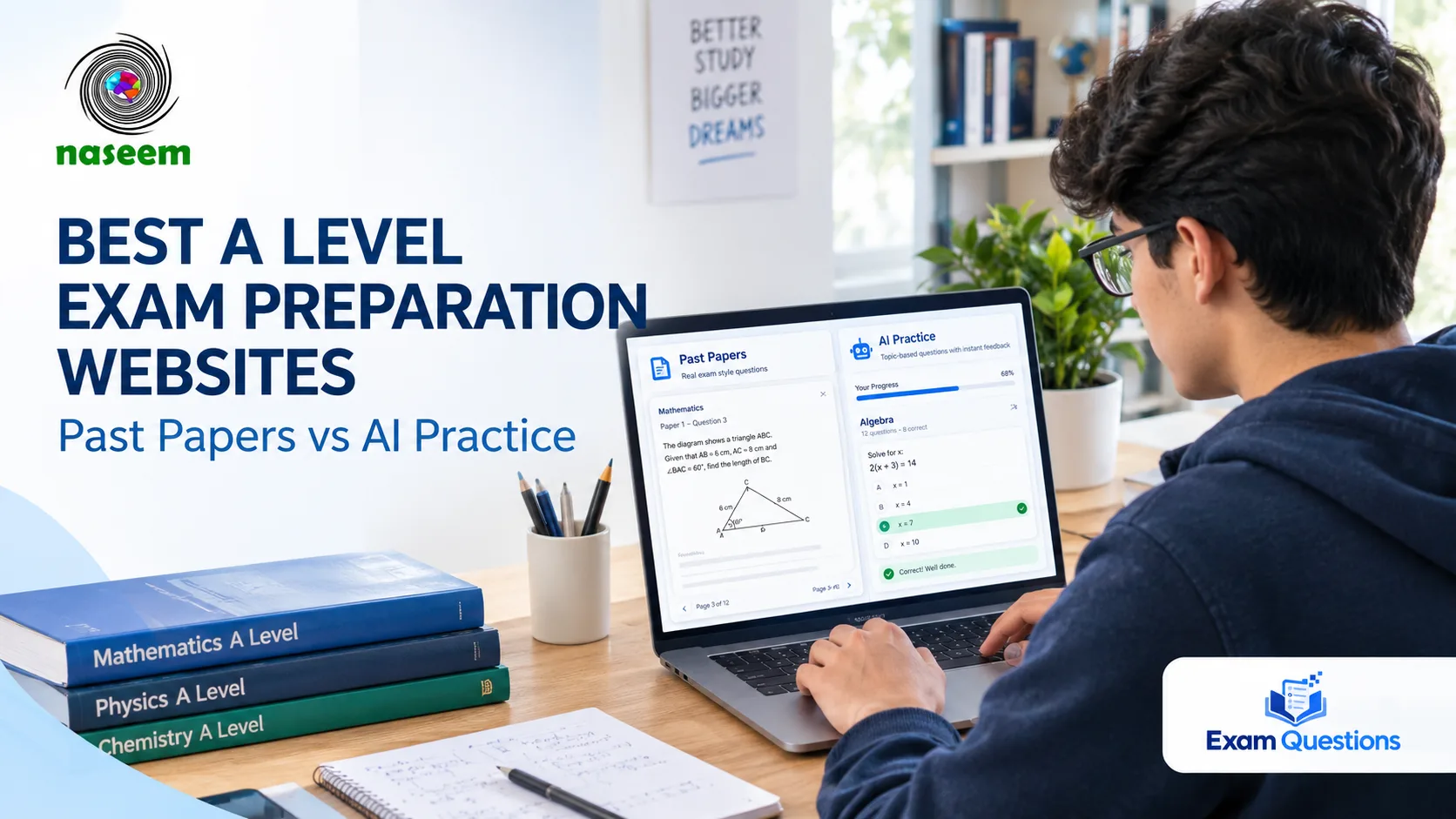
Best A Level Exam Preparation Websites and Tools: Past Papers vs AI Practice
Preparing for A Levels is not simply a matter of spending more hours with a textbook. Students need to understand the syllabus, remember important concepts, apply what they have learned to unfamiliar questions, and explain their reasoning in the way an examination requires. Finding the right study resources can make that process more organized, especially when several subjects demand attention at the same time.
The challenge is that there are so many options. Some websites provide official past papers and mark schemes. Others offer revision notes, video lessons, topic-based questions, worked solutions, or online tutoring. Newer platforms also use artificial intelligence to generate practice questions, evaluate answers, or provide explanations.
These resources serve different purposes, so choosing one should depend on what you need to improve rather than how many features a website advertises.
For example, a student who understands a topic but struggles to apply it in an examination may benefit more from timed practice than from reading another set of notes. Someone who repeatedly loses marks on structured questions may need to study mark schemes and examine how answers are developed. A student who has finished the available questions on a particular topic may want additional practice.
This guide compares the main types of A Level exam preparation websites and tools, explains the role of official past papers, and explores where AI-assisted practice can fit into a sensible revision routine.
If you are preparing for Cambridge International AS & A Levels, you can begin by exploring the official Cambridge International AS & A Level qualifications and then choose supplementary resources according to your subject, syllabus, and learning needs.
What Makes an A Level Exam Preparation Website Useful?
A useful preparation website should help you do more than collect information. It should support the actual work involved in learning a subject and preparing for an examination.
Before choosing a platform, consider the following questions.
Does it match your examination board and syllabus?
This is one of the first things to check. A resource can explain a concept correctly but still be unsuitable for your examination if it follows a different syllabus, assessment structure, or specification.
Cambridge International, Pearson Edexcel, and other examination providers may differ in subject content, question formats, assessment objectives, and examination requirements. Even where two qualifications share a subject name, their syllabuses should not automatically be treated as interchangeable.
For Cambridge International students, the official subject directory provides a starting point for finding the relevant qualification and subject information.
Check the subject code, syllabus version, examination session, and topics covered before relying on a third-party resource. If a website does not make its syllabus coverage clear, verify its materials against the official specification.
Can you practice instead of only reading?
Reading notes can help you understand a concept, but recognition is not the same as being able to reproduce or apply that knowledge independently.
A good preparation resource should make it possible to test yourself. Depending on the subject, that might involve solving mathematical problems, interpreting experimental data, explaining a scientific process, evaluating an economic argument, or writing a structured response.
Practice also exposes weaknesses that passive revision can hide. A student may feel comfortable with a topic while reading a worked example, then discover that they cannot complete a similar question without assistance.
Choose resources that allow you to attempt questions before looking at answers.
Are answers and explanations available?
An answer tells you whether you reached a result. An explanation can help you understand why that result is correct.
This difference matters when you make a mistake. If you cannot identify the reason behind it, you may repeat the same error in the next question.
For numerical subjects, useful feedback may show the relevant formula, substitution, calculation, units, and final result. For longer responses, feedback should help you examine the relevance of your points, the accuracy of your knowledge, the structure of your argument, and the requirements of the question.
However, not every resource provides equally detailed explanations. Some provide only final answers, while others offer worked solutions or commentary. Check what is actually available before choosing a platform.
Can you identify the topics that need more attention?
Students often spend too much time revising familiar material because it feels productive. A more balanced approach allocates time according to the importance of each topic, the requirements of the syllabus, and the student's current level of understanding.
A useful preparation tool should make it easier to recognize where further study is needed. This does not necessarily require sophisticated analytics. A simple record of questions attempted, errors made, and topics requiring review can be valuable.
The important point is to use your results to decide what to study next rather than completing questions without a plan.
1. Official Past Papers and Mark Schemes
Official past papers are among the most important resources for students preparing for Cambridge International A Levels.
They let students examine the structure of actual examinations, practice answering questions under realistic conditions, and compare their responses with the relevant mark schemes.
Cambridge International explains that past papers help learners become familiar with examination requirements and command words, while mark schemes explain how answers should meet assessment objectives. Its teaching, learning and assessment resources provide further guidance.
Why past papers matter
Past papers help you understand how knowledge is assessed, not just what knowledge appears in the syllabus.
For example, a question may ask you to calculate a value, explain a process, compare two approaches, analyze information, or evaluate a statement. Each instruction calls for a different response.
Practicing actual examination questions helps you become familiar with these expectations. It also shows how much detail a question may require and how marks are allocated.
Past papers are particularly useful when you have completed your initial revision and want to check whether you can apply your knowledge independently.
How to use past papers effectively
Start by confirming that the paper matches your subject and relevant syllabus. Then decide whether you are practicing a particular topic or completing a full paper.
If you are still learning a topic, attempt a small selection of questions without a strict time limit. Focus on understanding the method and the reasoning behind each answer.
When you are preparing for the examination itself, complete a suitable paper under timed conditions. Avoid checking notes halfway through unless you are deliberately doing an open-book exercise.
Afterwards, review your answers using the official mark scheme. Identify the points you missed, the steps you performed incorrectly, and the questions that took too long.
Record those mistakes and revisit them during later revision.
The limitations of past papers
Past papers are valuable, but they are not a complete revision strategy on their own.
First, students can become familiar with particular questions without fully understanding the concepts behind them. Repeating the same paper may improve the score while leaving gaps in knowledge.
Second, past papers cover particular examination sessions and specifications. They should not be treated as a guarantee that future examinations will repeat the same questions.
Third, the number of available papers is limited. Students who need repeated practice on one difficult topic may benefit from additional questions after working through the relevant official material.
Use past papers as a foundation, then supplement them with syllabus review, textbook study, teacher guidance, and other suitable practice resources.
2. Official Syllabuses, Specimen Papers, and Examiner Resources
Past papers show you examples of examination questions. The syllabus explains what you are expected to learn.
That distinction is important because preparation based only on previous papers can leave students uncertain about the full scope of a subject.
The official Cambridge International AS & A Level website provides access to subject information and relevant resources, including syllabus overviews, past papers, examiner reports, and specimen papers where available.
Start with the syllabus
Use the syllabus as a checklist for your preparation. Break it into topics and subtopics, then assess your current understanding of each area.
You might classify topics as:
- Secure: You can explain the concept and answer relevant questions independently.
- Developing: You understand the main ideas but still make mistakes.
- Needs review: You struggle to recall or apply the material.
These categories are a practical planning method, not an official examination classification.
Revisit the checklist regularly. Your priorities should change as your knowledge improves.
Use specimen papers to understand examination requirements
Specimen papers can help you become familiar with a particular assessment structure, particularly when a syllabus or examination format has changed.
Check that the specimen paper applies to your qualification and syllabus version. Do not assume that every available paper reflects the current examination format.
Learn from examiner reports and candidate responses
Where available, examiner reports can help students understand recurring weaknesses in responses. Example candidate responses may also show how different answers meet assessment requirements.
Use these resources to improve your understanding of what a question demands. If you repeatedly lose marks because your explanations are incomplete, for example, practice writing more precise answers and compare them with the relevant guidance.
Official resources are particularly important when you need to verify examination requirements. Third-party websites may provide useful explanations, but they should not replace the official syllabus or current examination instructions.
3. Revision Websites and Online Learning Resources
Revision websites can be helpful when you need a clear explanation of a difficult concept or want to review a topic before attempting examination questions.
Depending on the platform, resources may include concise notes, diagrams, video lessons, worked examples, quizzes, flashcards, and topic summaries.
When revision websites are useful
Suppose you are studying a challenging topic in Physics. You understand the definitions but cannot explain how a particular principle applies to a practical situation.
A well-structured explanation or worked example may help you connect the underlying concept with the type of reasoning required.
Similarly, a student studying Economics may benefit from reviewing a concept, examining a diagram, and then attempting a question that requires analysis and evaluation.
Revision resources can make difficult material easier to revisit. They can also provide an alternative explanation when your textbook or classroom notes have not resolved a misunderstanding.
What to check before relying on a revision website
Look for clear syllabus coverage, accurate explanations, and examples that are relevant to your qualification.
Be cautious with pages that do not identify their sources, contain unexplained errors, or present simplified explanations as if they cover every examination requirement.
Also consider whether the resource encourages active learning. A collection of attractive notes may be easy to browse without necessarily helping you apply the material.
After reviewing an explanation, close the page and try to summarize the concept from memory. Then attempt a relevant question without assistance.
That simple step can help you determine whether you have understood the topic or merely recognized the explanation.
4. Online Question Banks and Topic-Based Practice
Question banks provide another way to prepare for examinations. Rather than completing a full past paper, students can focus on a particular topic or skill.
This approach is especially useful when a student has identified a specific weakness.
For example, a Mathematics student might need more practice with integration. A Biology student may want to improve answers involving experimental data. A Business student may need to practice applying a concept to a case study.
Topic-based questions allow students to concentrate on these areas before moving to mixed or full-paper practice.
Why focused practice can help
When you attempt several questions on one topic, you can compare the methods required and identify recurring mistakes.
You may discover that you understand the concept but frequently make algebraic errors. Alternatively, you may know the relevant facts but struggle to apply them to unfamiliar information.
These are different problems and require different solutions.
Focused practice helps you identify which part of the process needs attention.
What makes a question bank worthwhile?
Check whether questions are organized by subject and topic, whether answers are available, and whether explanations are sufficient for independent study.
Also check how the questions were created and whether they are aligned with your examination requirements.
Some platforms may provide original questions, while others reproduce or organize existing materials. Understand what you are using and follow the relevant copyright and access conditions.
A large number of questions is not automatically a sign of quality. Accurate questions that test the intended skill are more useful than a large collection containing irrelevant or poorly explained material.
5. AI-Assisted A Level Exam Preparation Tools
AI-assisted preparation tools add another option to the resources available to students.
Depending on the product, these tools may help generate practice questions, explain concepts, provide feedback on answers, or organize study activities. Their capabilities vary, so students should assess the actual features of each platform rather than assuming that every AI tool works in the same way.
How AI-assisted practice may help
Imagine that you have revised a topic and completed the questions available in your textbook. You want to continue practicing without immediately repeating the same examples.
A suitable tool may provide additional questions or help you explore a concept from a different angle.
Alternatively, you may have written an answer but feel uncertain about its clarity or completeness. An AI-assisted feedback tool may help you identify possible weaknesses and suggest areas to review.
These uses can make revision more interactive, provided you verify important information and continue to practice independently.
What AI cannot reliably guarantee
AI-generated material is not automatically accurate, syllabus-aligned, or representative of an official examination.
A question may contain a factual error, omit a necessary condition, use an unsuitable difficulty level, or fail to match the expected assessment style. An automatically generated explanation may also sound convincing while containing an error.
For longer responses, automated feedback may miss subject-specific nuances or interpret an answer differently from an official mark scheme.
For that reason, treat AI as a support tool rather than the final authority on examination requirements.
Check important information against your syllabus, textbooks, teacher guidance, and official resources. When a question or explanation appears inconsistent, investigate it before learning it as fact.
When to use AI alongside other resources
AI-assisted practice is most useful when it fills a clear gap in your existing revision routine.
Use official materials to understand the examination requirements. Use textbooks and trusted explanations to build knowledge. Use additional practice to apply what you have learned. Then use feedback to decide what needs further attention.
This approach is more reliable than asking an AI tool to plan your entire preparation without checking its recommendations.
For a closer look at combining AI tools with past papers, answer feedback, and syllabus review, see our guide on how to use AI for A Level exam preparation.
6. Exam Questions: An Additional Resource for A Level Practice
Exam Questions is an online exam-preparation platform focused on A Level subjects. It offers exam-style practice questions and AI-assisted features intended to help students practice, review answers, and understand mistakes.
It can be considered alongside official past papers, textbooks, and other revision resources, particularly when a student wants more opportunities to practice.
What students can use it for
Students preparing for supported A Level subjects can explore the platform to see whether its practice and feedback features match their revision needs.
Its approach is centered on question-based preparation rather than relying exclusively on reading notes. AI-assisted marking and explanations can also provide an additional way to review responses, subject to the capabilities and limitations of the tool.
Before using any platform for a particular subject, check that it supports your qualification and the topics you are studying.
You can start at the Exam Questions website and review the available subjects and features directly.
Where it fits in a preparation plan
Exam Questions should be viewed as a supplementary practice option, not a replacement for official Cambridge resources.
For example, a student might review a topic using the prescribed textbook, attempt relevant official past-paper questions, and then use additional practice to reinforce the same skill.
If feedback suggests that an answer is incomplete, the student can revisit the topic and consult an official mark scheme or teacher before attempting another question.
This combination gives each resource a clear purpose.
Official papers help students understand real examination requirements. Textbooks support subject knowledge. Additional practice creates more opportunities to apply that knowledge. Feedback helps students decide what to review.
Is it the right option for every student?
Not necessarily. The best resource depends on the subject, syllabus, learning preferences, available budget, and the type of support required.
Students who primarily need official examination documents should begin with Cambridge International. Students who need classroom explanations may benefit from teacher support or a trusted revision resource. Students looking for additional question practice can evaluate Exam Questions and compare its actual features with other options.
The sensible approach is to choose resources based on their usefulness rather than assuming that one website must meet every preparation need.
If AI-assisted feedback and marking are part of what you're evaluating, see our guide on how to use AI for A Level exam preparation for a closer look at that approach.
7. Comparing the Main Types of A Level Preparation Resources
The following comparison explains what each resource type is generally suited to. It is not a ranking of individual websites, and the exact features available will depend on the provider.
| Resource type | Best suited to | Important limitation |
|---|---|---|
| Official past papers | Understanding real examination questions and practicing under timed conditions | Limited to the papers and sessions available |
| Official syllabuses | Checking subject coverage and examination requirements | Do not provide all the practice or teaching support a student may need |
| Mark schemes and examiner resources | Reviewing answer requirements and learning from mistakes | Students must apply the guidance to their own responses |
| Revision websites | Reviewing concepts and finding alternative explanations | Quality and syllabus alignment vary |
| Topic-based question banks | Practicing specific skills and identifying recurring errors | Question quality and relevance vary |
| AI-assisted tools | Generating additional practice or receiving feedback, depending on the tool | May produce incorrect questions, explanations, or assessments |
| Human tutors and teachers | Clarifying misunderstandings and receiving individualized guidance | Availability, cost, and quality vary |
| Exam Questions | Exploring additional A Level question practice and AI-assisted feedback | Verify subject support and check AI-generated feedback against trusted sources |
Instead of selecting a platform based on its category alone, evaluate its features against the problem you want to solve.
If you repeatedly run out of questions on a particular topic, additional practice may be useful. If you cannot understand a concept, prioritize a reliable explanation or teacher support. If your answers are correct but you lose marks, investigate the assessment requirements and the way you present your reasoning.
8. How to Choose the Right Preparation Tools for Your Subject
Different A Level subjects require different kinds of practice. A useful revision plan reflects those differences.
Mathematics
For Mathematics, prioritize accurate methods, clear working, and repeated practice across relevant topics.
Use official questions to understand the examination style. When you make a mistake, determine whether the problem came from the underlying concept, the choice of method, an algebraic step, or a calculation.
Additional questions can help reinforce the method, but do not rely on final answers alone. Make sure you understand why each step is valid.
Physics
Physics requires both conceptual understanding and the ability to apply principles to unfamiliar situations.
Practice calculations, explanations, graphs, experimental questions, and other relevant assessment tasks. Check units, assumptions, significant figures where required, and the relationship between the physical quantities involved.
When using AI-generated explanations, verify equations and scientific claims against trusted learning materials.
Chemistry
Chemistry preparation may involve recalling knowledge, understanding reactions, interpreting data, performing calculations, and explaining chemical principles.
Use the syllabus to identify the full scope of the subject. Practice both knowledge-based and application-based questions, and pay attention to the wording required in structured answers.
For any generated question involving equations, reaction conditions, or numerical calculations, verify that the chemistry is correct.
Biology
Biology requires accurate terminology, clear explanations, and the ability to interpret information.
Practice questions involving processes, data, experimental design, and relationships between biological concepts. Review feedback carefully to identify missing steps or imprecise language.
Use the official syllabus and trusted materials to check the accuracy of definitions and explanations.
Business and Economics
Business and Economics often require students to apply knowledge to a context, analyze consequences, and support judgements with relevant reasoning.
Simply memorizing definitions may not prepare you to answer questions that ask for application or evaluation.
Practice explaining why a point matters, linking arguments to the scenario, considering alternative outcomes, and reaching a justified conclusion where required.
Use feedback to examine the quality of your reasoning rather than focusing only on the number of facts included.
Computer Science and English Language
Computer Science students should practice the specific programming, algorithmic, theoretical, and problem-solving skills required by their syllabus.
English Language students should focus on the relevant analytical and writing tasks, including how they structure responses and use evidence from texts where required.
In both subjects, verify that practice materials reflect the current syllabus and expected assessment style. A generic AI-generated question may not adequately test the skills required in a particular examination.
9. How to Combine Past Papers, Question Banks, and AI Practice
The most useful revision routine is one in which each activity has a clear purpose.
Step 1: Establish what you need to learn
Begin with the official syllabus and your current notes. Identify the topics that require revision and the skills you need to demonstrate.
Do not start by completing random questions simply because they are available.
Step 2: Review the relevant concepts
Use your textbook, class notes, teacher guidance, or another trusted learning resource to address gaps in understanding.
Try to explain the concept in your own words before moving on.
Step 3: Attempt questions independently
Start with questions appropriate to your current level of understanding. Avoid looking at the answer immediately.
Write out your reasoning, calculations, or explanation as you would in an examination.
Step 4: Review your mistakes
Use official mark schemes where applicable. Identify missing knowledge, incorrect methods, incomplete explanations, and avoidable errors.
If you use AI-assisted feedback, treat it as an additional perspective and verify important points against trusted materials.
Step 5: Practice the weak areas again
Choose new questions that test the skill you struggled with. If the same error occurs repeatedly, return to the underlying concept instead of simply completing more questions.
Step 6: Move to timed examination practice
When you are comfortable with the relevant topics, attempt suitable past papers under timed conditions.
Review both your accuracy and your use of time. A good score on an untimed exercise does not automatically mean you are ready to complete a full examination within the allotted time.
Step 7: Review your progress
Keep a record of your attempts, recurring mistakes, and topics that need further revision.
Use this information to adjust your plan. Progress is not simply the number of questions completed; it is also the extent to which you can answer them accurately and independently.
10. Common Mistakes When Choosing Exam Preparation Websites
Students can waste time by choosing resources that look impressive but do not address their actual needs.
Choosing quantity over quality
A website with thousands of questions is not necessarily more useful than one with a smaller, well-organized collection. Check accuracy, syllabus relevance, and the quality of the available answers.
Treating AI predictions as exam forecasts
No third-party practice tool can guarantee that a generated question will appear in a future examination. Use AI-generated questions to practice relevant concepts, not as a substitute for learning the syllabus.
Ignoring official materials
Even a useful commercial platform cannot replace the need to understand the official assessment requirements.
Keep the current syllabus, relevant past papers, and mark schemes at the center of your preparation.
Repeating questions without reviewing mistakes
Completing more questions has limited value if you do not understand why you answered incorrectly. Review your errors and choose follow-up practice that addresses them.
Switching between too many platforms
Using several websites can create unnecessary complexity. Start with a small set of reliable resources and add another only when it fills a genuine gap.
Final Thoughts: Choose Resources That Help You Learn
The best A Level exam preparation strategy is not built around one website. It combines accurate subject knowledge, official examination resources, independent practice, and thoughtful review.
Start with the syllabus. Use official past papers and mark schemes to understand the examination requirements. Turn to trusted explanations when a concept is unclear, and use additional question banks or AI-assisted tools when you need more opportunities to practice.
If you want to explore another option for A Level question practice, visit Exam Questions and check its supported subjects and available features. Consider how those features fit into your existing routine rather than replacing the resources you already trust.
The aim is not to complete the largest number of questions or use the most tools. It is to build the knowledge, accuracy, and confidence needed to answer examination questions independently.
A sensible next step: Choose one topic you find difficult, review its syllabus requirements, attempt a few relevant questions, and record what you need to improve. Then select the resource that directly addresses that weakness.
Frequently Asked Questions
Ready to Bring Your School’s Learning Together?
Give your school a connected learning management system designed to support students, teachers, parents, and school leaders.