
Virtual University LMS vs Naseem Education LMS: Which Learning Management System Is Better?
Learning management systems have changed the way educational institutions deliver courses, communicate with learners, manage assessments, and keep track of academic progress. In Pakistan, one of the best-known examples is the Virtual University of Pakistan's Learning Management System (VULMS), which supports the university's online learning model.
But an important question arises when the requirements change.
Is a university LMS the right choice for a modern school?
This is where the comparison between Virtual University LMS and Naseem Education LMS becomes interesting.
VULMS is closely connected with Virtual University's distance-learning environment and provides registered students with access to their academic activities through a centralized online system. Naseem Education takes a different approach, focusing specifically on the wider school community — students, teachers, parents, and school leaders.
So, which learning management system is better?
The honest answer depends on who is using it and what they expect an LMS to do.
For a university student looking for access to a university's digital academic environment, VULMS serves an important purpose. For a school looking for a broader platform that connects learning, teaching, assessment, student progress, parents, teachers, and school leadership, Naseem Education offers a more school-focused approach.
Let's compare them in detail.
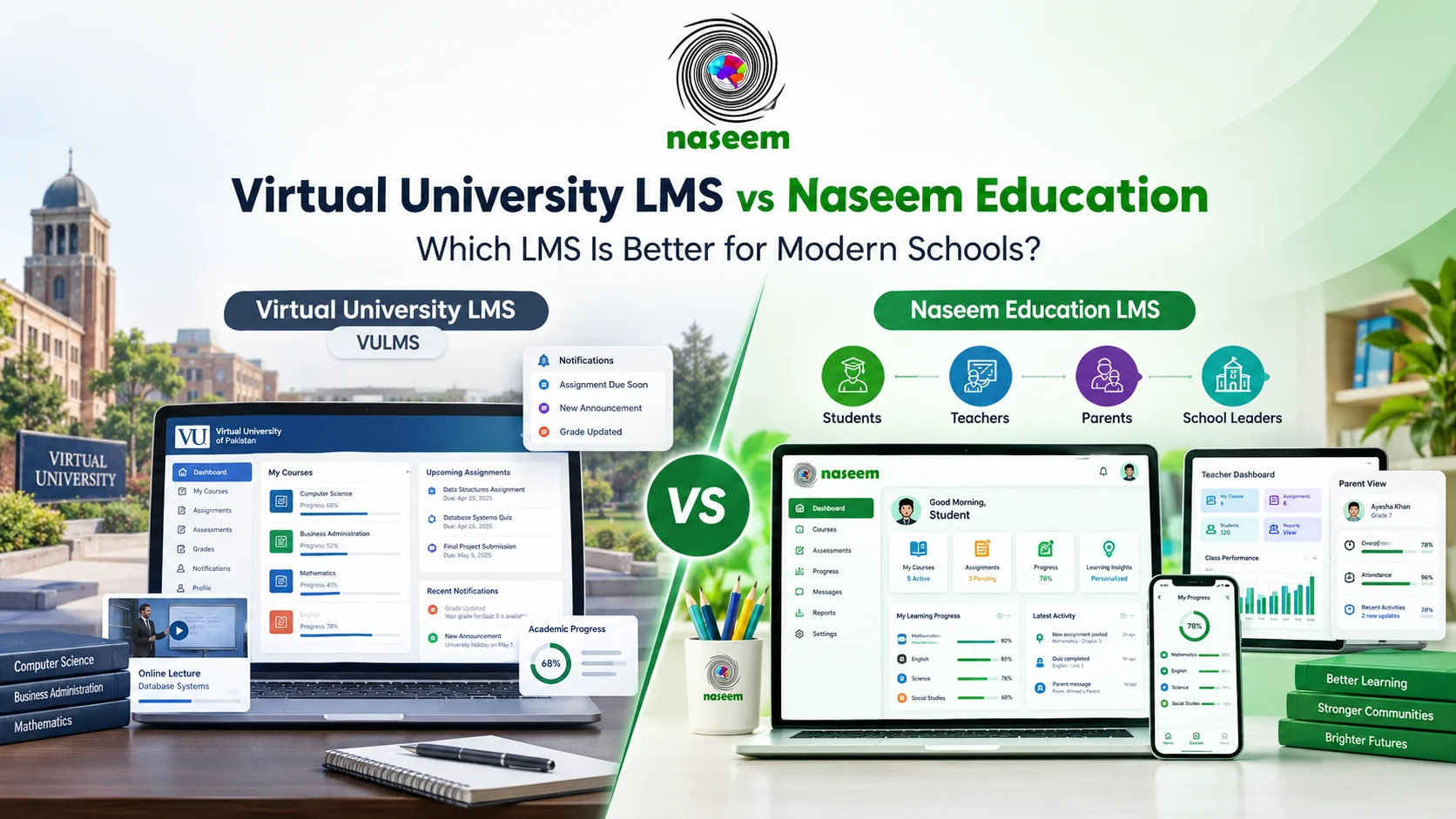
What Is the Virtual University LMS?
The Virtual University of Pakistan LMS, commonly known as VULMS, is the Learning Management System used by Virtual University students.
The official VULMS portal provides student login using a student ID and password and includes access points such as the notice board, student handbook, datesheet-related information, and other university learning functions.
VULMS is therefore an important part of Virtual University's online education environment. Students enrolled with the university use the system as part of their academic journey.
For anyone searching for virtual university LMS, virtual university of Pakistan LMS, or LMS Virtual University of Pakistan, VULMS is the platform those searches generally refer to.
But there is an important distinction to understand.
VULMS is built around the requirements of a university.
A school has a different structure.
Schools don't only have students and instructors. They also have parents, principals, coordinators, academic leaders, administrators, and different grade levels. A school LMS therefore needs to address a wider set of day-to-day educational relationships.
That difference is at the heart of the comparison.
What Is Naseem Education LMS?
Naseem Education is a learning management system designed specifically around the needs of modern schools.
Instead of focusing only on course delivery, its platform brings together learning, assessments, student progress, teacher workflows, parent visibility, and school-level insights in one environment.
The platform is designed for four key groups:
- Students
- Teachers
- Parents
- School leaders
Students can access courses, learning activities, assessments, feedback, and progress information. Teachers can manage learning activities, assessments, and student performance. Parents can stay connected with relevant aspects of their child's academic progress, while school leaders can use broader learning information to understand institutional trends.
This makes Naseem Education less about simply putting lessons online and more about creating a connected digital learning environment for schools.
Quick Comparison: VULMS vs Naseem Education LMS
At a glance, VULMS and Naseem Education serve different educational needs. VULMS is built around Virtual University's online university-learning environment, while Naseem Education is designed specifically for the broader requirements of modern schools.
| Feature | VULMS | Naseem Education LMS |
|---|---|---|
| Primary focus | University education | School education |
| Students | ✓ | ✓ |
| Online courses | ✓ | ✓ |
| Assignments & assessments | ✓ | ✓ |
| Student progress tracking | ✓ | ✓ |
| Teacher management | ✓ | ✓ |
| Parent engagement | Not a primary focus | ✓ |
| School leadership insights | University-focused | ✓ |
| Personalized learning | — | ✓ |
| Learning analytics | ✓ | ✓ |
| Multilingual learning | — | ✓ |
| School-wide ecosystem | Not the primary focus | ✓ |
In simple terms: VULMS is a strong fit for Virtual University students and its university-based learning model. Naseem Education is more specifically aligned with schools that want to connect students, teachers, parents, and school leaders through one learning platform.
So, if you're searching for the Virtual University of Pakistan LMS, VULMS is the relevant platform. But if you're a school looking for a modern, school-focused LMS with broader collaboration, progress tracking, parent engagement, and institutional insights, Naseem Education deserves closer consideration.
Virtual University LMS vs Naseem Education LMS: The Main Difference
The simplest way to understand the difference is to look at the institutions each platform is designed around.
VULMS is part of a university learning environment.
Naseem Education is designed as a school learning environment.
Both belong to the broader LMS category, and there is naturally some overlap between their capabilities. However, the people using the platforms and the way educational institutions operate are different.
A university student may primarily need access to courses, academic resources, assessments, schedules, and university communication.
A school may need all of those things while also involving parents, teachers, principals, academic coordinators, and administrators in the learning process.
That distinction becomes particularly important when a school starts evaluating an LMS.
Virtual University LMS vs Naseem Education LMS: Feature Comparison
The following comparison looks at the platforms from the perspective of an institution evaluating an LMS.
| Area | Virtual University LMS (VULMS) | Naseem Education |
|---|---|---|
| Primary environment | University education | School education |
| Online learning | Yes | Yes |
| Course management | Yes | Yes |
| Student learning activities | Yes | Yes |
| Assessments | Yes | Yes |
| Student progress | Academic/student-focused | Student and school-focused |
| Teacher tools | Supports university teaching environment | School-focused teacher management |
| Parent involvement | Not the central focus of the platform | Dedicated parent engagement |
| School leadership visibility | University-oriented environment | School-level insights |
| Personalized learning | Depends on the learning environment | Built into the platform's school-focused approach |
| Learning analytics | Academic environment | Teacher and school leadership insights |
| Auto-grading | Depends on specific academic activity | Supported |
| Gamified learning | Not the central positioning | Supported |
| Multilingual learning | Not the central positioning | Designed to support 20+ languages |
| School-wide learning environment | Not the primary purpose | Core positioning |
| Core platform model | Not the primary model | Students + teachers + parents + leaders |
The important point is not that one platform is universally better than the other.
It is that the right LMS depends on the institution using it.
For schools, that difference can be significant.
Is VULMS a Good LMS?
Yes — for its intended university environment, VULMS plays an important role.
Virtual University has built its education model around online learning, and its LMS is an essential part of that experience. The official VULMS portal identifies itself as the Learning Management System of Virtual University of Pakistan and provides students with access to their university learning environment.
However, saying that VULMS is useful for Virtual University students does not automatically mean that the same model is the best fit for every school.
This is a common mistake when comparing LMS platforms.
An LMS should be evaluated according to the institution's actual requirements.
A university and a school don't operate in exactly the same way.
Why a School LMS Needs More Than Course Delivery
Imagine a secondary school with 800 students.
The school needs teachers to manage their classes. Students need access to lessons and assignments. Parents want to understand how their children are progressing. School leaders want to see broader academic trends.
The LMS therefore becomes more than a place where students log in and read course material.
It becomes a shared environment connecting the people involved in learning.
That is the model behind Naseem Education.
Its platform brings together course management, learning activities, assessments, progress tracking, teacher management, parent engagement, analytics, personalized learning, gamification, multilingual learning, and web/mobile access.
For schools, this wider approach can make a significant difference.
Naseem Education LMS for Students
A student shouldn't have to treat an LMS as nothing more than a digital folder.
The learning environment should help students understand:
- What they need to learn
- Which activities they need to complete
- How they are performing
- Where they need improvement
- What feedback their teachers have provided
- How their progress is developing
Naseem Education is designed to bring these parts of the learning experience together.
Students can access courses, learning activities, assessments, feedback, personalized learning experiences, and progress information through the platform.
This creates a more connected experience than simply putting educational files online.
Naseem Education LMS for Teachers
Teachers are at the center of a school's learning process.
A useful LMS should therefore make teachers' work easier rather than adding another system they have to manage.
Naseem Education provides teachers with tools for managing learning activities, assessments, student performance, and progress information from a connected environment. Its platform also includes assessment and auto-grading capabilities intended to reduce repetitive work.
This can help teachers spend less time jumping between disconnected tools and more time understanding what their students actually need.
For schools interested in the wider LMS features that matter most, the important thing is not the number of features listed on a product page. What matters is how those features work together during everyday teaching.
Naseem Education LMS for Parents
This is one of the clearest areas where a school-focused LMS can have a different role from a university LMS.
Parents are an important part of the school community.
They may want to know:
- How their child is progressing
- Whether assignments are being completed
- How academic performance is changing
- Where additional support may be needed
- What achievements their child has made
Naseem Education includes parent engagement as part of its school LMS approach, giving parents visibility into relevant aspects of their child's learning progress, performance, achievements, and areas requiring attention.
This is particularly useful for schools where parents are expected to remain involved in the learning journey.
Naseem Education LMS for School Leaders
A school principal or academic leader needs a different view of learning.
They may not need to see every individual assignment, but they do need to understand what is happening across the institution.
For example:
- Are students progressing?
- Which classes need attention?
- Are assessments being completed?
- Where are learning gaps appearing?
- What academic trends are developing?
- How are different groups of students performing?
Naseem Education's learning analytics and school-level insights are designed around this type of institutional visibility.
This is an important difference in perspective.
A student needs to understand their progress.
A teacher needs to understand their students.
A school leader needs to understand the school.
A school LMS should be able to support all three perspectives.
Virtual University LMS vs Naseem Education LMS for Pakistani Schools
For Pakistani schools, the comparison becomes even more relevant.
The LMS market in Pakistan is growing as schools and educational institutions adopt more digital approaches to teaching, assessment, communication, and academic management.
However, schools should not choose an LMS simply because it is well known or because another educational institution uses it.
The better question is:
Does the platform fit the way our school actually works?
For a university student, VULMS makes sense because it is part of Virtual University's academic ecosystem.
For a school, the requirements can be considerably broader.
A school may need:
- Student management
- Course management
- Teacher tools
- Assessments
- Progress tracking
- Parent engagement
- School-level reporting
- Learning analytics
- Personalized learning
- Communication
- Mobile access
- Multilingual support
This is where a dedicated school LMS such as Naseem Education becomes worth considering.
For a broader overview of the Pakistani market, schools can also explore this guide to the Learning Management System in Pakistan and compare the requirements of different types of educational institutions.
Which LMS Is Better for Schools: VULMS or Naseem Education LMS?
If the question is:
“Which LMS should a Virtual University student use?”
The answer is straightforward: VULMS is the university's official LMS, so its students should use the system provided by their institution. The official VULMS portal is the appropriate starting point for VU students.
But if the question is:
“Which platform should a Pakistani school evaluate for its own learning environment?”
The comparison changes.
Naseem Education has been designed specifically around school requirements.
Its focus extends beyond course access to include students, teachers, parents, and school leaders. The platform combines learning management with assessments, progress tracking, analytics, personalized learning, parent engagement, and other school-focused capabilities.
For that reason, Naseem Education can be a stronger fit for schools looking for a dedicated school LMS rather than a university learning portal.
Why Naseem Education LMS Can Be a Better Choice for Modern Schools
There are several reasons a school may prefer a school-focused LMS.
1. It is designed around schools
Naseem Education is not positioned as a generic course-hosting tool. Its LMS is designed around students, teachers, parents, and school leaders.
2. Parents are part of the learning ecosystem
Parents can have relevant visibility into their child's learning progress and performance instead of being completely disconnected from the digital learning environment.
3. Teachers get a broader view of student performance
Course activities, assessments, feedback, and progress information can be brought together so teachers have more context when supporting students.
4. School leaders get institutional insights
Learning analytics can help school leaders understand broader academic trends rather than relying only on individual reports.
5. Personalized learning is part of the approach
Students do not always learn at the same speed or in the same way. Naseem Education's platform includes personalized learning capabilities intended to support different student needs.
6. It goes beyond basic course hosting
A modern LMS needs to connect learning, assessment, feedback, progress, and communication. That broader approach is central to Naseem Education's positioning.
VULMS vs Naseem Education LMS: Which One Should You Choose?
There is no reason to pretend that every institution needs the same LMS.
If you are a Virtual University student, VULMS is the obvious platform for accessing your university's online academic environment.
If you are a school looking for an LMS, your requirements are different.
You need to think about the entire school community.
Ask yourself:
- Can students access their courses easily?
- Can teachers manage learning and assessments?
- Can student progress be monitored?
- Can parents remain informed?
- Can school leaders see useful academic insights?
- Can the platform support personalized learning?
- Can the system grow with the school?
- Does it work well across modern devices?
- Can it support the languages and needs of your school community?
If the answer to these questions matters to your institution, a school-focused LMS deserves serious consideration.
The Bottom Line
The comparison between Virtual University LMS and Naseem Education is not really about deciding which platform is universally better.
They are designed around different educational environments.
VULMS is the Learning Management System used by Virtual University of Pakistan and is closely connected to the university's online education model.
Naseem Education takes a school-focused approach, bringing together students, teachers, parents, and school leaders through one digital learning environment. Its platform covers course management, online learning, assignments, assessments, auto-grading, progress tracking, teacher management, parent engagement, learning analytics, personalized learning, gamification, and multilingual learning.
So, if you are looking for the LMS used by Virtual University, VULMS is the platform you are looking for.
But if you are a Pakistani school searching for a modern LMS that is designed around the wider school community, Naseem Education is an option worth evaluating.
The better LMS is ultimately the one that fits the institution.
And for a modern school, the LMS should do more than deliver lessons.
It should help the entire school understand, manage, and improve learning.
Ready to Explore a School-Focused LMS?
If your school is looking beyond basic online course delivery and wants a connected environment for students, teachers, parents, and school leaders, explore Naseem Education's Learning Management System to see how the platform can support your school's digital learning environment.
Frequently Asked Questions
Ready to Bring Your School’s Learning Together?
Give your school a connected learning management system designed to support students, teachers, parents, and school leaders.
More Articles
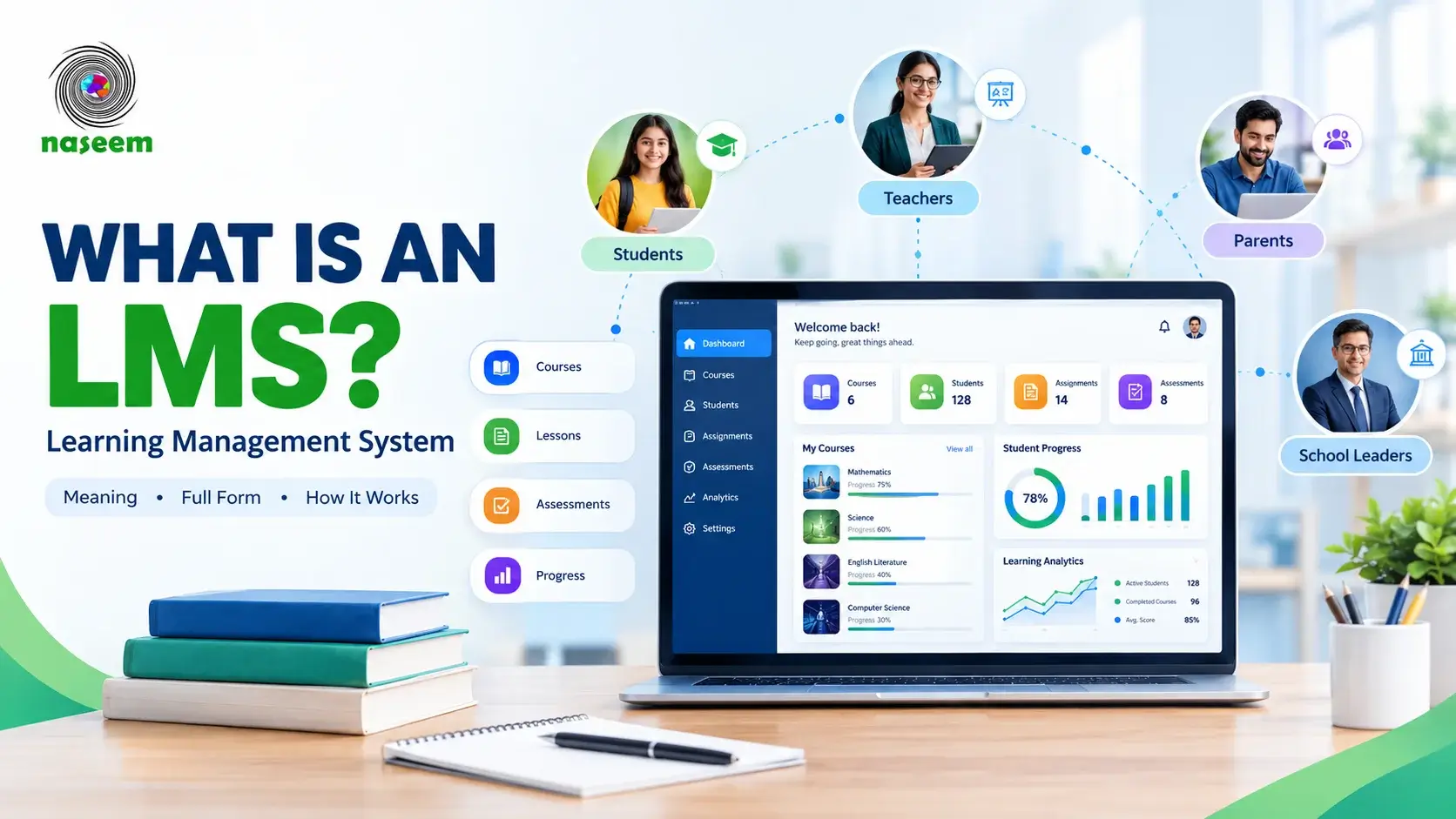
What Is an LMS? Learning Management System Meaning, Full Form & How It Works
Learn what an LMS is, what LMS stands for, how a learning management system works, its key features, benefits, and how schools use LMS software.
Read Article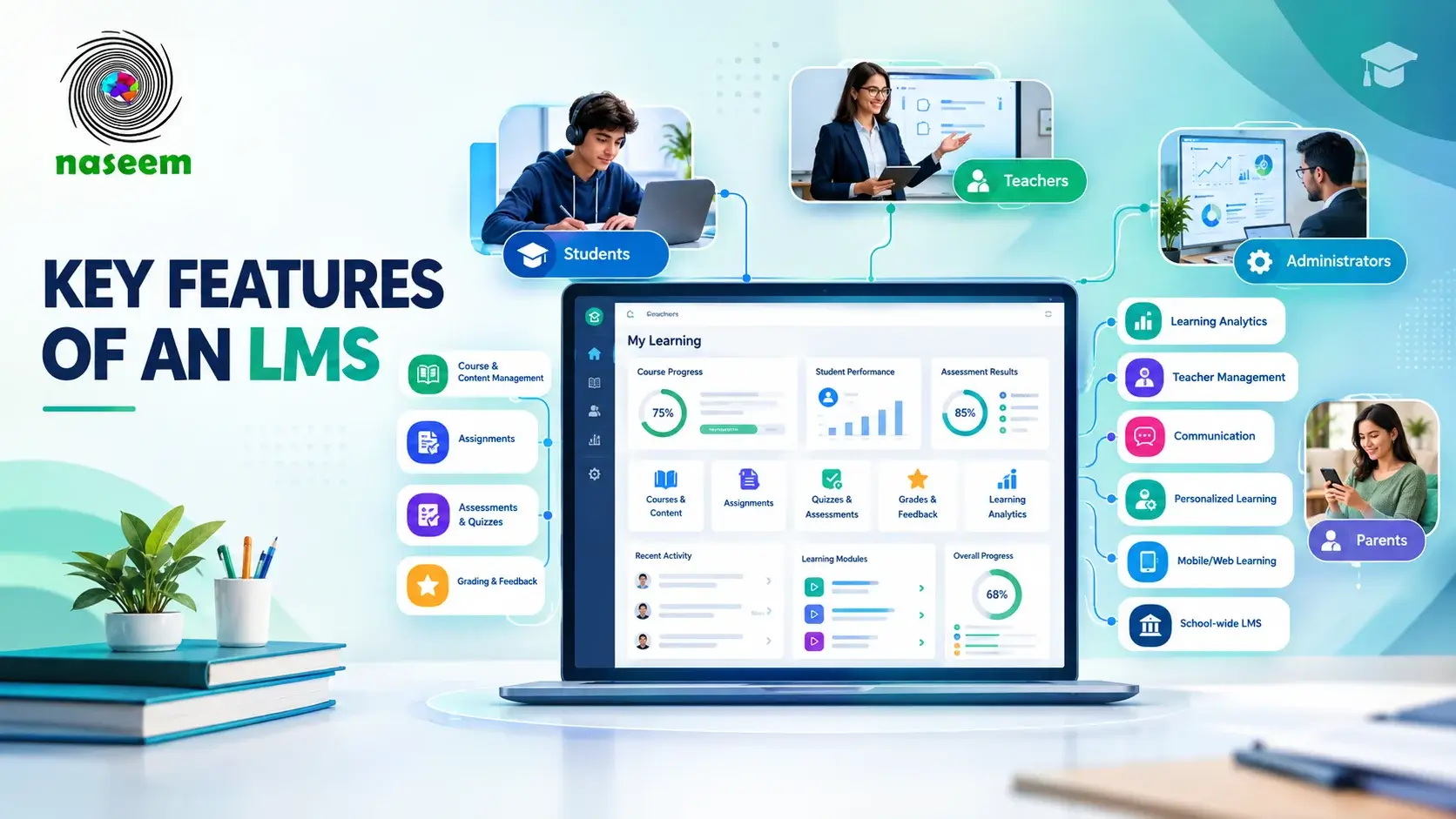
What Are the Key Features of an LMS? 15 Essential Features Explained
Explore 15 essential LMS features, including course management, assessments, grading, progress tracking, analytics, mobile access, and more.
Read Article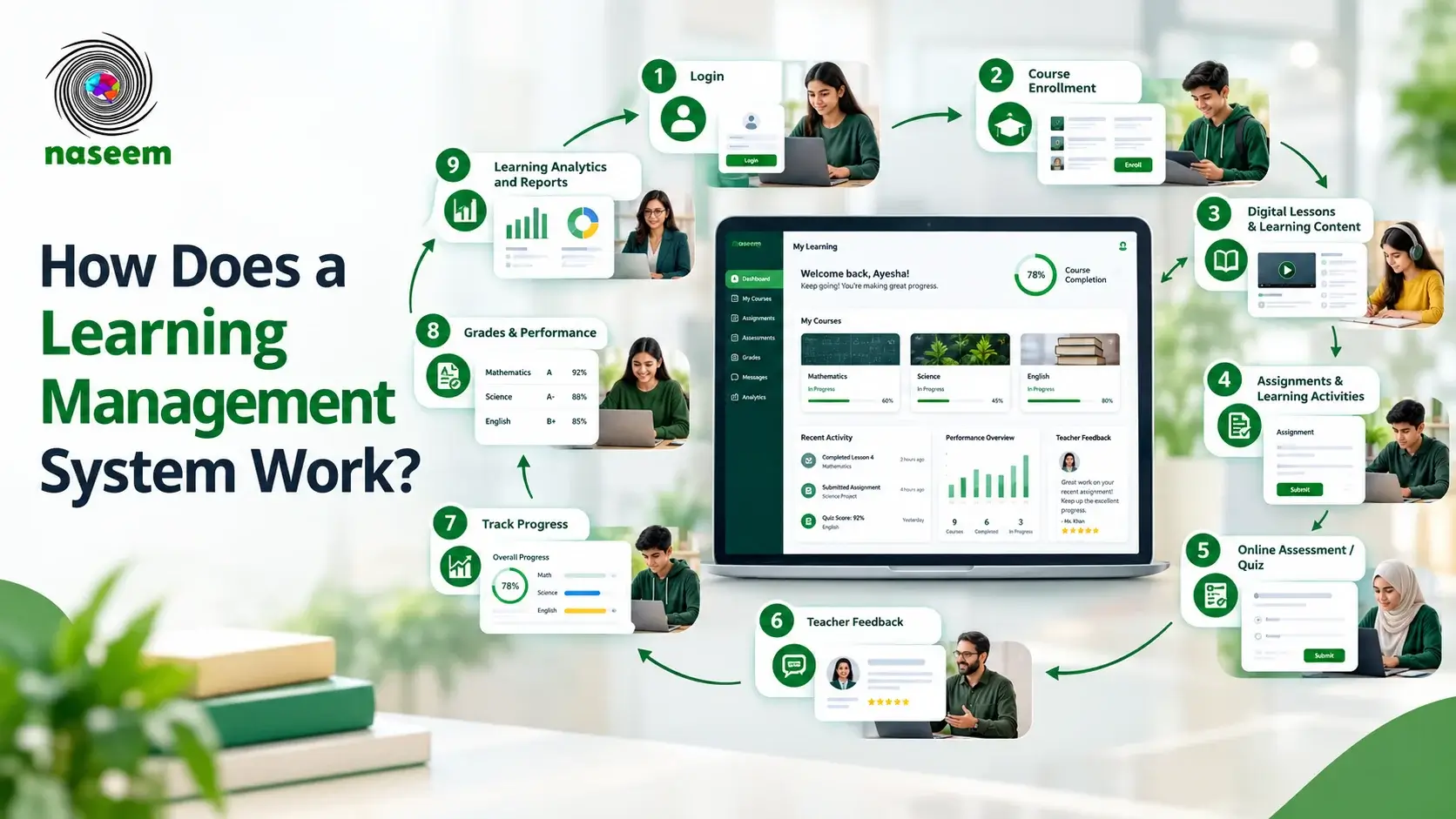
How Does a Learning Management System Work? A Complete Guide
Learn how a learning management system works, from course enrollment and content delivery to assessments, progress tracking, reporting, and feedback.
Read Article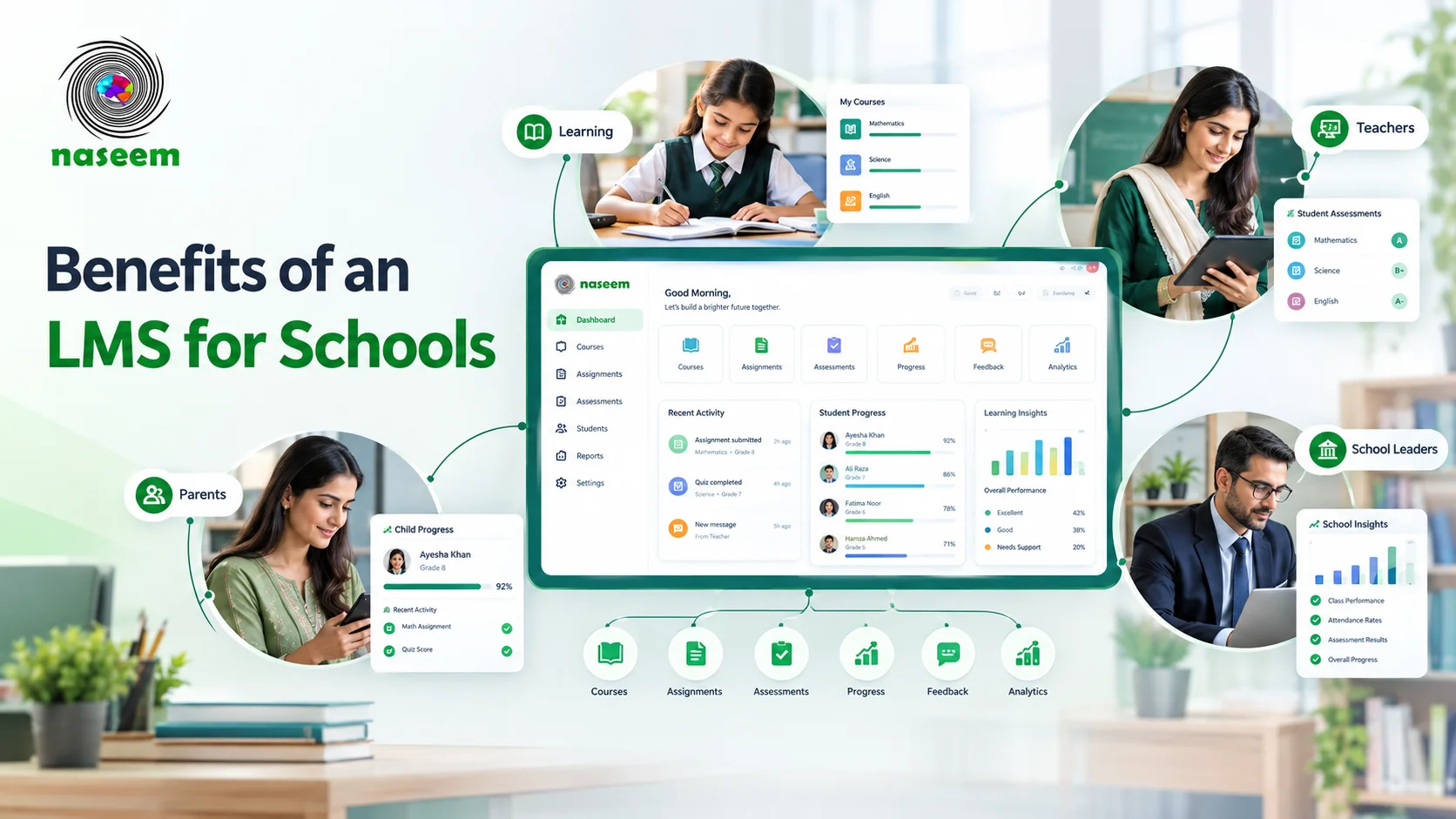
Benefits of a Learning Management System for Schools
Explore LMS benefits for schools, from student progress tracking and feedback to teacher support, parent visibility, and learning analytics.
Read Article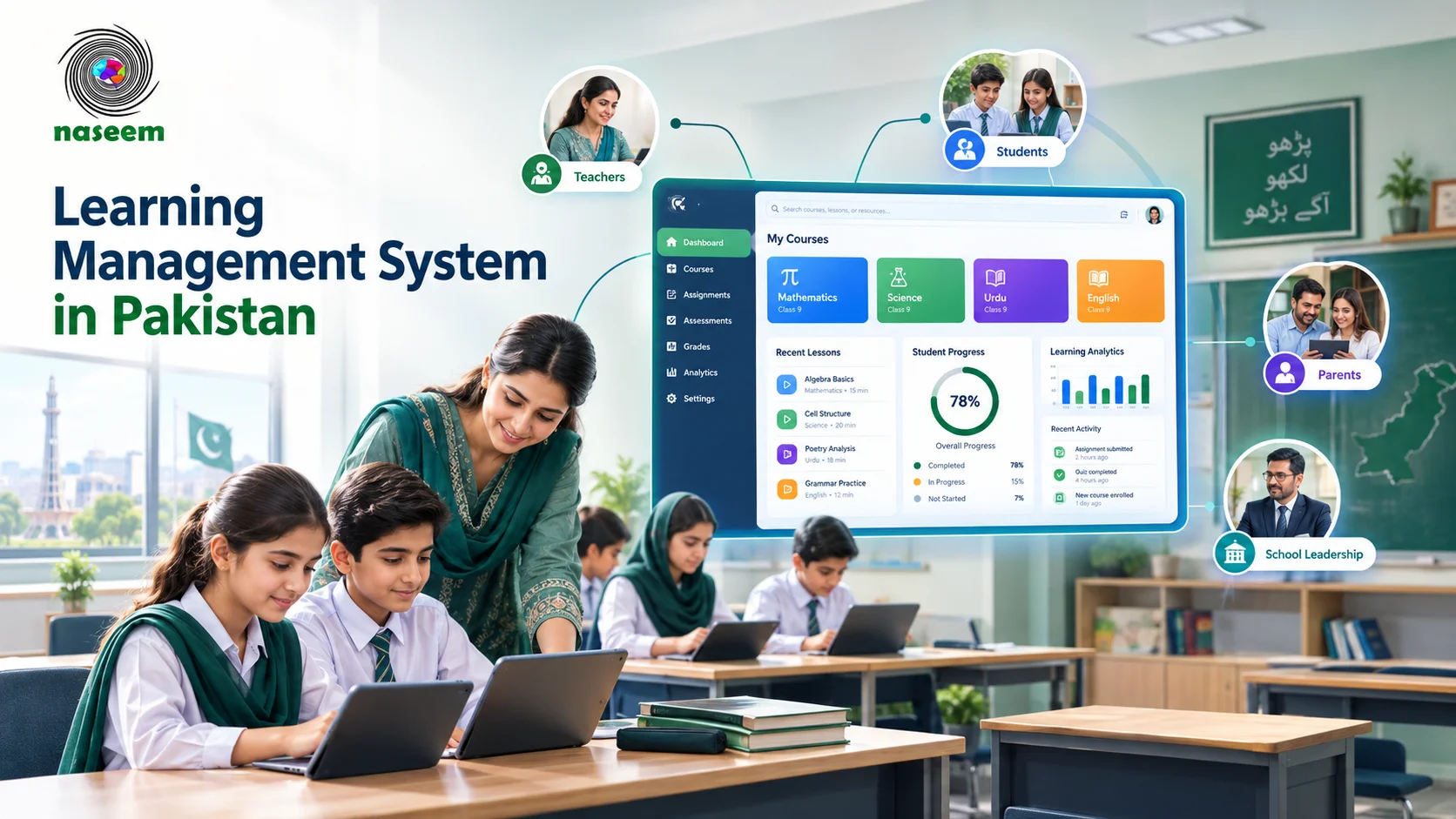
Learning Management System in Pakistan: Complete Guide for Schools
Learn how a learning management system works in Pakistan, what schools should look for, LMS costs, implementation, features and more.
Read Article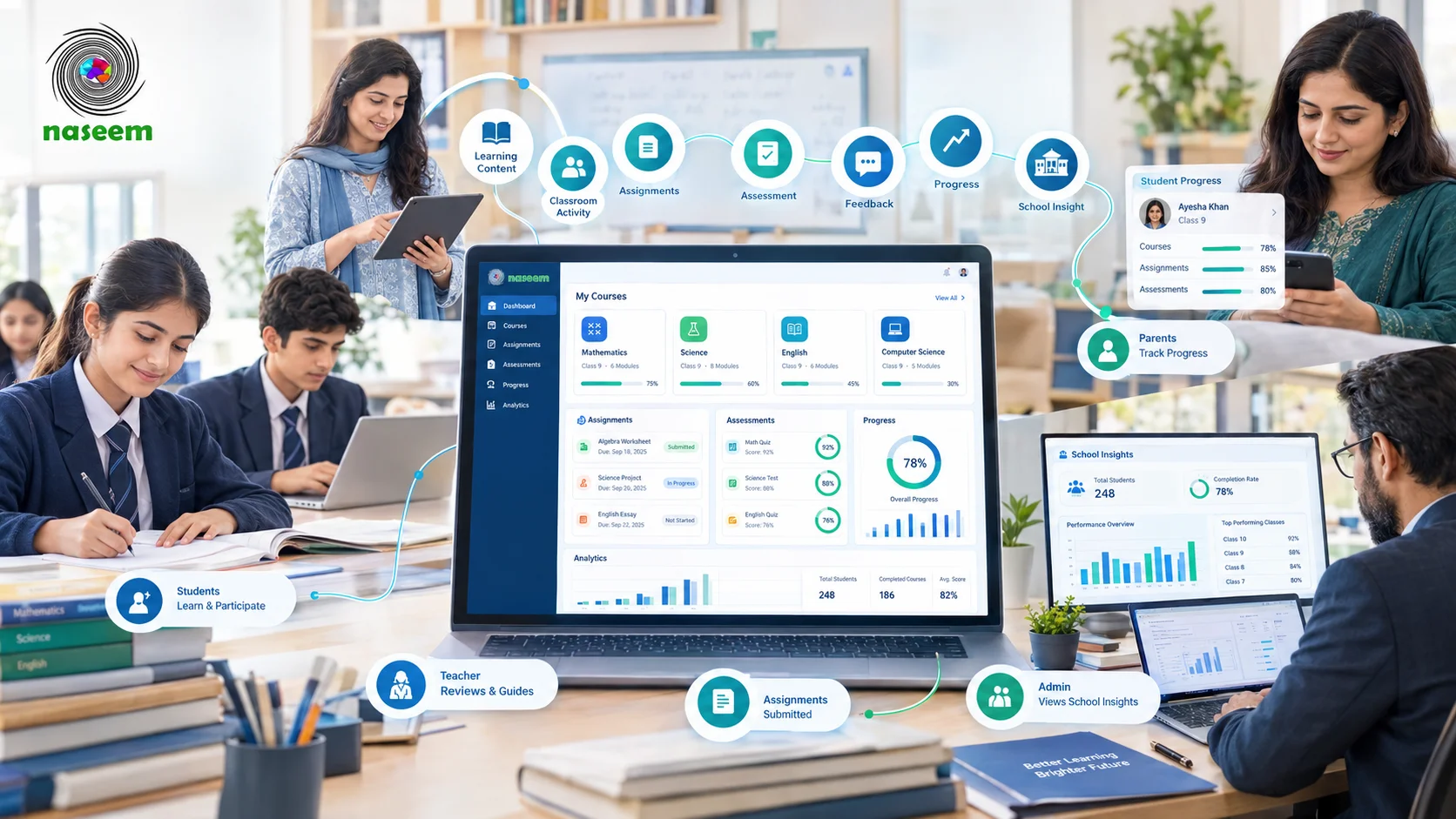
Learning Management System for Schools: Complete Guide
Learn how a learning management system for schools works, what features to look for, how to choose one, and how to implement it.
Read Article